Mathematics

Article teaser image

Math Professor Makes Division Baseball Predictions - Erroneously Picks Pirates To Finish Last

New Jersey Institute of Technolgy math professor Bruce Bukiet is once again opining on outcomes for this season’s Major League Baseball teams. His picks are based on a mathematical model he developed in 2000. Bukiet’s main areas of research have involved mathematical modeling of physical phenomena, including detonation waves, healing of wounds, and dynamics of human balance. He has also applied mathematical modeling to sports and gambling, in particular for understanding baseball and cricket. Bukiet is an avid Mets fan but no one should hold that against him. “I use my mathematical model to…
Article teaser image

You Are What You Eat? Not According To Dynamical Systems Theory

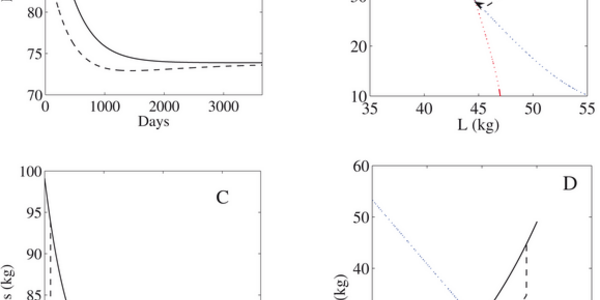
If identical twins eat and exercise equally, will they have the same body weight? Not really, say NIH investigators Carson Chow and Kevin Hall. They analyzed the fundamental equations of body weight change and found that identical twins with identical lifestyles can have different body weights and different amounts of body fat. The study uses a branch of mathematics called dynamical systems theory to demonstrate that a class of model equations has an infinite number of body weight solutions, even if the food intake and energy expenditure rates are identical. However, the work also shows…
Article teaser image

Statistics Are Insufficient For Study Of Proteins' Signal System

Nearly ten years ago an article published in Science [Lockless SW, Ranganathan R (1999) Science 286:295–299] got a lot of attention. It described a method of demonstrating signal transfer in proteins by comparing their amino acid sequence. The authors recorded a statistical method of showing how certain parts of proteins change together through evolution, i.e. if a change had taken place in one part a change simultaneously took place in another part of the protein. They found a network of parts that seemed to belong together and, within this network, signal transfer was deemed to take place…
Article teaser image

Infinite Solution To 'Euler’s Equation Of Degree Four' Discovered

Recently, mathematician Daniel J. Madden and retired physicist Lee W. Jacobi found solutions to a puzzle that has been around for centuries - an infinite number of solutions for a puzzle known as 'Euler’s Equation of degree four.' The equation is part of a branch of mathematics called number theory. Number theory deals with the properties of numbers and the way they relate to each other. It is filled with problems that can be likened to numerical puzzles. “It’s like a puzzle: can you find four fourth powers that add up to another fourth power" Trying to answer that question is difficult…
Article teaser image

Natural Selection Applies In Business Also, Say Researchers

There are a number of interconnected factors that lead to the success or failure of any business so it is usually considered an impossible task to predict whether a company will sink or swim numerically but researchers in Taiwan using the principles of evolutionary biology say they have devised an approach to spotting when a company is likely to fail. Ping-Chen Lin of the National Kaohsiung University of Applied Sciences in Kaohsiung and Jiah-Shing Chen of the National Central University, Jhongli, in Taiwan, also explain how their metric of the financial status of any company can be of…
Article teaser image

Mythical Third Degree Transcendental L-Function Spotted At AIM Meeting

A new mathematical object was revealed yesterday during a lecture at the American Institute of Mathematics (AIM). Two researchers from the University of Bristol exhibited the first example of a third degree transcendental L-function. These L-functions encode deep underlying connections between many different areas of mathematics. The news caused excitement at the AIM workshop attended by 25 of the world's leading analytic number theorists. The work is a joint project between Ce Bian and his adviser, Andrew Booker. Booker commented that, "This work was made possible by a combination of…
Article teaser image

Can More Physicists And Fewer Politicans Resolve The Global Warming Debate?

Science has developed sophisticated models of the atmosphere and instruments can help make detailed weather forecasts but to truly understand global climate change, scientists need more than just a one-day forecast or a seven-day guess. They need a deeper understanding of the complex and interrelated forces that shape climate. They need applied mathematics, says Brad Marston, professor of physics at Brown University. He is working on sets of equations that he says can be used to more accurately explain climate patterns. “Climate is a statement about the statistics of weather, not the day-to…
Article teaser image

140 Year-Old Schwarz-Christoffel Math Problem Solved

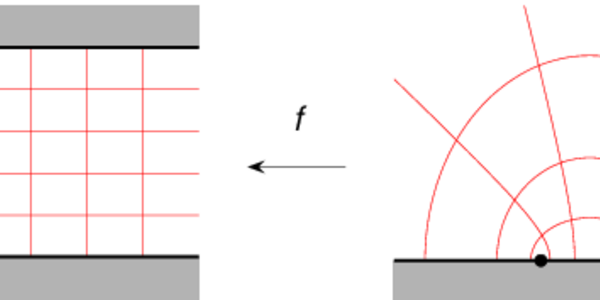
A problem which has defeated mathematicians for almost 140 years has been solved by a researcher at Imperial College London. Professor Darren Crowdy, Chair in Applied Mathematics, has made the breakthrough in an area of mathematics known as conformal mapping, a key theoretical tool used by mathematicians, engineers and scientists to translate information from a complicated shape to a simpler circular shape so that it is easier to analyze. This theoretical tool has a long history and has uses in a large number of fields including modelling airflow patterns over intricate wing shapes in…
Article teaser image

The Fractal Approach To Theories Of (City) Evolution

A new way of looking at cities has emerged during the last 20 years that could revolutionise planning and ultimately benefit city dwellers. ‘The Size, Scale and Shape of Cities’ in Science advocates an integrated approach to the theory of how cities evolve by linking urban economics and transportation behaviour with developments in network science, allometric growth and fractal geometry. Professor Batty argues that planning’s reliance on the imposition of idealised geometric plans upon cities is rooted in the nineteenth century attitude which viewed cities as chaotic, sprawling and dirty.…
Article teaser image

Zig Or Zag? A New Mathematical Model Tells How We Master Steep Slopes

A straight line may be the shortest distance between two points, but it isn’t necessarily the fastest or easiest path to follow. That’s particularly true when terrain is not level, and now researchers have developed a mathematical model showing that a zigzag course provides the most efficient way for humans to go up or down steep slopes. “I think zigzagging is something people do intuitively,” said Marcos Llobera, a University of Washington assistant professor of anthropology who is a landscape archaeologist. “People recognize that zigzagging, or switchbacks, help but they don’t realize why…