Genetics & Molecular Biology
VIEW ALL →
Evolution
VIEW ALL →
Microbiology
VIEW ALL →
Ecology & Zoology
VIEW ALL →
Immunology
VIEW ALL →
Neuroscience
VIEW ALL →

Life Sciences

Article teaser image

Global microplate reader market during pandemic

A microplate reader is one of the key methods of determining the chemical or biological properties of samples inserted into microtiter plates. The medical field has used it in their studies of microorganisms such as viruses and various biotechnological fields which include but are not limited to drug discovery, vaccine development and manufacturing, and bioassay validation.  Aside from maximizing on operations, efficiency, cost, and accuracy, microplate readers can also facilitate researchers with easy data analysis. These microplate readers can detect all kinds of reactions emitted…
Article teaser image

The Insect Spreading Citrus Death

In recent years the citrus industry has suffered a dramatic decrease in production. The iconic Florida citrus industry is in a disease-induced decline, ravaged by a pathogen that has cut the production to half of what it was only a decade or so ago. Why is This Happening? This devastating decline in production is the result of a disease called Huanglongbing (HLB), or Citrus Greening. The disease has been detected in all Florida citrus-growing counties and now has spread throughout the south and into citrus-growing regions of California. HLB is one of the most serious citrus diseases in the…
Article teaser image

Decline in greenhouse gas emissions would reduce sea-level rise, save Arctic Sea ice

The threat of global warming can still be greatly diminished if nations cut emissions of heat-trapping greenhouse gases by 70 percent this century, according to a new analysis. While global temperatures would rise, the most dangerous potential aspects of climate change, including massive losses of Arctic sea ice and permafrost and significant sea-level rise, could be partially avoided. The study, led by scientists at the National Center for Atmospheric Research (NCAR), will be published next week in the American Geophysical Union journal Geophysical Research Letters. It was funded by the…
Article teaser image

Biofuels could hasten climate change

April 14, 2009 – A new study finds that it will take more than 75 years for the carbon emissions saved through the use of biofuels to compensate for the carbon lost when biofuel plantations are established on forestlands. If the original habitat was peatland, carbon balance would take more than 600 years. The study appears in Conservation Biology. The oil palm, increasingly used as a source for biofuel, has replaced soybean as the world's most traded oilseed crop. Global production of palm oil has increased exponentially over the past 40 years. In 2006, 85 percent of the global palm-oil crop…
Article teaser image

Cuts in greenhouse gas emissions would save Arctic ice, reduce sea level rise

BOULDER--The threat of global warming can still be greatly diminished if nations cut emissions of heat-trapping greenhouse gases by 70 percent this century, according to a new analysis. While global temperatures would rise, the most dangerous potential aspects of climate change, including massive losses of Arctic sea ice and permafrost and significant sea level rise, could be partially avoided. The study, led by scientists at the National Center for Atmospheric Research (NCAR), will be published next week in Geophysical Research Letters. It was funded by the Department of Energy and the…
Article teaser image

Mathematics and climate change

Providence, RI---In 1994, University of Utah mathematician Ken Golden went to the Eastern Weddell Sea for the Antarctic Zone Flux Experiment. The sea's surface is normally covered with sea ice, the complex composite material that results when sea water is frozen. During a powerful winter storm, Golden observed liquid sea water welling up and flooding the sea ice surface, producing a slushy mixture of sea water and snow that freezes into snow-ice. With his mathematician's eyes he observed this phenomenon and said to himself: "That's percolation!" Golden is an expert in mathematical models of…
Article teaser image

Ancestors of African Pygmies and neighboring farmers separated around 60,000 years ago

All African Pygmies, inhabiting a large territory extending west-to-east along Central Africa, descend from a unique population who lived around 20,000 years ago, according to an international study led by researchers at the Institut Pasteur in Paris. The research, published April 10 in the open-access journal PLoS Genetics, concludes that the ancestors of present-day African Pygmies and farmers separated ~60,000 years ago. Pygmies are characterized by a forest-dwelling hunter-gathering lifestyle and distinctive cultural practices and physical traits (e.g., low stature). Two groups of Pygmy…
Article teaser image

Solomon Islands earthquake sheds light on enhanced tsunami risk

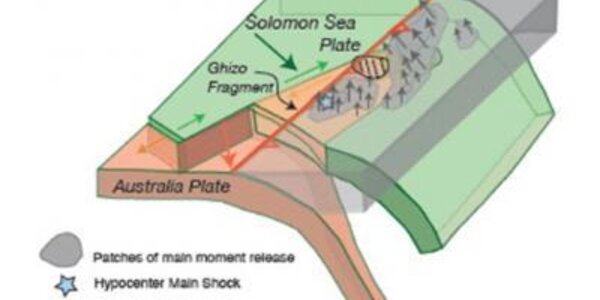
The 2007 Solomon Island earthquake may point to previously unknown increased earthquake and tsunami risks because of the unusual tectonic plate geography and the sudden change in direction of the earthquake, according to geoscientists. On April 1, 2007, a tsunami-generating earthquake of magnitude 8.1 occurred East of Papua New Guinea off the coast of the Solomon Islands. The subsequent tsunami killed about 52 people, destroyed much property and was larger than expected. "This area has some of the fastest moving plates on Earth," said Kevin P. Furlong, professor of geoscience, Penn State…
Article teaser image

Understanding risk to Seattle's high-rise buildings from a giant Cascadian earthquake

Session: Deterministic Simulated Ground Motion Records Under ASCE/SEI (7-05: Guidance for the Geotechnical Industry Location: DeAnza Ballroom 3, Thursday 9 April 2009, 8:30 a.m. The Cascadia subduction zone is likely to produce the strongest shaking experienced in the lower 48 states. Although seismic activity in the Pacific Northwest has been relatively low in the past two centuries, there is a growing consensus that this fault zone ruptures in giant earthquakes (magnitude exceeding 9); the last rupture is inferred to have occurred in 1700. What is the risk to high-rise buildings from…
Article teaser image

UNH: Pavement sealcoat a source of toxins in stormwater runoff

DURHAM, N.H. – Driveways and parking lots may look better with a layer of sealcoat applied to the pavement, but the water running off the surface into nearby streams will be carrying more than just oxygen and hydrogen molecules. New research conducted at the University of New Hampshire Stormwater Center (UNHSC) indicates that sealcoat may contribute to increasingly significant amounts of polyaromatic hydrocarbons entering waterways from stormwater runoff. Polyaromatic hydrocarbons, more commonly known as PAHs, are found in diesel and crude oil and are considered to be carcinogenic. Although…