Mathematics

Article teaser image

Welcome to 42

Welcome to October 10th, 2010, 10/10/10, unless you are in Europe, where they will write it 10/10/10 just to be different.  If you are a fan of binary counting, 101010 translated to decimal is...42.   If you are a fan of Douglas Adams, you know that the "answer to life, the universe, and everything" arrived at by the Deep Thought supercomputer was "42" ... after 7+ million years of analysis(1). Obviously, an answer like '42' was a perfect example of understated British humor and Adams was a master of the craft.    But before his death in 2001 and since, people have…

Article teaser image

Science Of Baseball Playoffs: Giants To Win LDS, But Don't Bet The House

Is a 52% chance of winning a prediction?   Well, yes and no. Today begins the Major League Baseball Division Series and New Jersey Institute of Technology associate math professor Bruce Bukiet is back again, performing his analysis of the probability of each team advancing to the League Championship Series. According to Bukiet's mathematical model, the Phillies have a 64% chance of winning their series against the Reds, the Texas Rangers have a 54% chance of defeating the Tampa Bay Rays, the Yankees have a 53% chance of defeating the Minnesota Twins and our local San Francisco Giants…
Article teaser image

Baseball Heresy - A Purist Mathematically Argues For The Unthinkable; More Playoffs

Living in California now, I follow my third 'home' team in my life.   Growing up in Vero Beach, FL I was (and remain) a Dodgers fan because they held spring training there for 60 years.   As an adult living in Pittsburgh I was (and remain) a Pirates fan because they were the new home team.   Now I live in northern California and the Giants are the home team (Oakland is technically closer by a few miles but when I say baseball I mean the National League - softball has 10 players and American League baseball has 10 players so I count both as separate sports), which can be…
Article teaser image

How Group Theory Dispelled My Worry About Mirrors

I remember, as a child, being very upset by a ventriloquist’s dummy at a show, and crying out and making a ‘scene’.  Even well into my teens and beyond, I felt disturbed by “magic”, even in mathematics or science.  One particular incident I remember was being shown in class the ‘proof’, by an elementary form a calculus of variations, that the shortest path[1] between two coordinates is a straight line.  This left me with an uncomfortable feeling.  That feeling, however, was dispelled when Mary Boas used calculus of variations in the Lagrangian formulation to derive the…
Article teaser image

Kuhn Poker Solved: Win Money With Game Theory

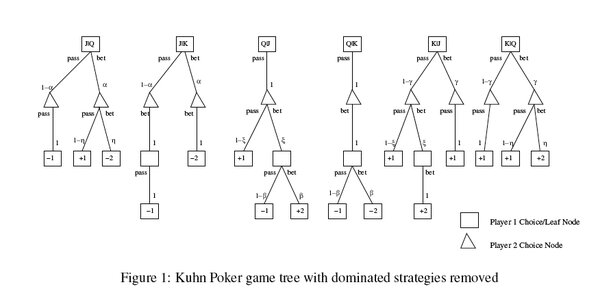
Yesterday I posted the rules of the very cool Kuhn poker. Here's optimal play: Playing first:Interestingly, you can either check or bet a King or a Jack—this is poker, after all and in this case bluffing/slow-playing is as good as playing your cards straight. But holding a Queen is tricky: If you bet, your opponent folds with a Jack or raises with a King. Half the time, you win your opponent's one-chip ante, and half the time you lose your ante plus your bet. This is not good. In fact, it's bad. You're losing twice as many chips as you're winning. So you check. Now your opponent only checks…
Article teaser image

Win Money With Game Theory: Kuhn Poker

Two players share a deck composed of three cards: Jack, Queen, and King. The highest card wins. You each ante one. You each get a card. The third card remains unseen. There's one standard round of betting, with a max bet of one chip each, giving the following choices: the first player can check or bet one. Player two can call, fold, check or raise one (as appropriate). If needed, player one can then call or fold (no re-raising). Imagine playing second: obviously, if you're confronted by a bet, there's no reason to call if you're holding the Jack and no reason to fold with a King (maybe, just…
Article teaser image

Mathematics Tackles Chaotic Big Bang Question

We want to know some things in science are absolute yet we accept that a lot is relative.    The speed of light is absolute and so the same with respect to any observer in empty space but sound is relative, like when a train whistle goes from high to low as it passes the observer.  A longstanding quest in physics has been to determine whether chaos, in which tiny events lead to very large changes in the time evolution of a system, such as the universe, is absolute or relative in systems governed by general relativity, where the time itself is relative.  Like right after…
Article teaser image

Coincidences Without Contingency

Coincidences in physics and in a sense infinite coincidences in mathematics are coincidences also because of the contingency around them: It could have been different. There is this type of coincidence that Tommaso was writing about that exemplifies contingency: We meet on the street wearing the same style of red jacked, both having a hole torn by some sort of mishaps. Contingency means that I could have bought a different style jacket and it could have been a different spot where I burned a hole into my jacket.Coincidence becomes interesting where contingency is questionable. That the…
Article teaser image

Statistics Suggest Brett Favre Will Not Win The Superbowl This Year

As a resident of the Elysian Fields that is the Twin Cities, I have been deluged by the Favreian Circus descending upon our fair binary metro area, and I. Am. So. Over. It. The bacchanal over Number Four's return has spread through the sports-writing world at ludicrous speed1 as has the dissolution of decades-long hatred among Vikings fans toward the former Cheesehead - hypocrites, the lot of you - but thus far I haven't come across a story that discusses regression toward the mean, which could be a factor in the upcoming NFL season. In his book The Drunkard's Walk, Leonard Mlodinow describes…
Article teaser image

NP=P Solved! $1M Millennium Prize?

Vinay Deolalikar from HP Labs claims proof of Millenium Prize problem P=NP, and (potential) $1M prize (pending peer review)! This deceptively simple little bugger (think e=mc^2) has, until now, stumped all suitors—basically it asks whether problems that have verifiable solutions should always be solveable front-to-back, as well as verifiable back-to-front. (Okay, that's massively simplistic, but going any deeper requires some serious CS.) Deolalikar's solution is a 100-page paper of dense to super-dense CS, which, with the $1M Clay Institute prize at stake, will certainly draw much attention…