Archaeology


Carnegie Mellon University’s Yang Cai is developing new technology that could revolutionize the way archeologists work. Cai, director of the Ambient Intelligence Lab at Carnegie Mellon CyLab, is developing new software to scan 200-year-old gravestones at Old St. Luke’s Church in nearby Carnegie to help its Episcopal pastor identify all the names on the cemetery’s tombstones.
“We are very excited and pleased that Professor Cai and his research team are helping us reclaim our past by identifying some of the 20 graves at our cemetery,” said Rev. Richard Davis, director of Old St. Luke’s Church…

Amihai Mazar, Eleazar L. Sukenik Professor of Archaeology at the Hebrew University, revealed that the first apiary (beehive colony) dating from the Biblical period has been found in excavations he directed this summer at Tel Rehov in Israel’s Beth Shean Valley. This is the earliest apiary to be revealed to date in an archaeological excavation anywhere in the ancient Near East, said Prof. Mazar. It dates from the 10th to early 9th centuries B.C.E.
Tel Rehov is believed to have been one of the most important cities of Israel during the Israelite monarchy. The beehives there were found in the…

It is summertime in Greece, and with it come the traditional wildfires. These are not natural forest fires; at least, it is thought that most of them are the result of deliberate arson. This is the product of a conflict between Greek law and society that has been going on for years. Most forested land in Greece is protected from development.
Those wishing to build sometimes respond by setting deliberate fires.
Sometime this is done in an amateurish way, other times explosives with remote detonators are used. Once the forest is burned down, the land becomes cheap and development can…
Excavations of an underwater Stone Age archaeological settlement dating back 8000 years are taking place at the National Oceanography Centre, Southampton.
Maritime archaeologists from the Hampshire and Wight Trust for Maritime Archaeology (HWTMA) have been working at the site just off the Isle of Wight coast. Divers working at depths of 11 metres have raised sections of the seabed, which have been brought to the NOCS laboratories for excavation.
Garry Momber, Director of HWTMA said: 'This is a site of international importance as it reveals a time before the English Channel existed when…

An artificial big toe attached to the foot of an ancient Egyptian mummy could prove to be the world's earliest functional prosthetic body part, say scientists. If true, the toe will predate what is currently considered to be the earliest known practical prosthesis - Roman Capua Leg from 300BC, made from bronze - by several hundred years. The leg was held at the Royal College of Surgeons in London but was destroyed by Luftwaffe bombs during the Second World War.
Research at The University of Manchester is hoping to prove that the wood and leather artefact in the Cairo Museum not only looked…
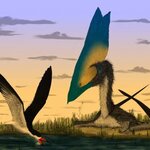
Scientists at the University of Sheffield, collaborating with colleagues at the Universities of Portsmouth and Reading, have taken a step back in time and provided a new insight into the lifestyle of a prehistoric flying reptile.
Using new physical and mathematical modelling, Dr Stuart Humphries from the University of Sheffield, along with scientists from the Universities of Portsmouth and Reading, has shown that suggestions that extinct pterosaurs gathered their food by ‘skimming’ the surface of the ocean with their beaks are inaccurate.
Physical and theoretical models show that pterosaurs…
Fossils discovered in the oft-painted arroyos of northern New Mexico show for the first time that dinosaurs and their non-dinosaur ancestors lived side by side for tens of millions of years, disproving the notion that dinosaurs rapidly replaced their supposedly outmoded predecessors.
The fossils were excavated from the Hayden Quarry at Ghost Ranch, an area made famous through the paintings of Georgia O'Keefe, by a team of paleontologists from the University of California, Berkeley, the American Museum of Natural History and The Field Museum. The finds, including fossil bones of a new dinosaur…
Preliminary results from DNA tests carried out on a mummy believed to be Queen Hatshepsut is expected to support the claim by Egyptian authorities that the remains are indeed those of Egypt’s most powerful female ruler.
Egyptologists in Cairo announced last month that a tooth found in a wooden box associated with Hatshepsut exactly fitted the jaw socket and broken root of the unidentified mummy.
Now, Dr Angelique Corthals, a biomedical Egyptologist at The University of Manchester, says that DNA tests she helped carry out with colleagues at the National Research Centre in Cairo have promising…
About 250 years before Daniel Massey built his farm house in Huntingdon County, Pennsylvania, his great-grandfather came to the New World as an indentured servant. 150 years later, Penn State's Archaeological Field School is excavating Daniel's house to see how far he came from those humble beginnings.
"I think historic archaeology can engage a little more directly than the prehistoric archaeology we sometimes do," says Dr. Claire Milner, director of the field school and director of exhibits and curator of Penn State's Matson Museum of anthropology. "It is more obvious and immediate who the…

Dr. Zahi Hawass
June 2007
When the Discovery Channel approached me to search for the mummy of Queen Hatshepsut, I did not really think I would be able to make a definite identification. But I did think that this would give me the perfect opportunity to look at the unidentified female mummies from Dynasty 18, which no one had ever studied in as a group. There were already many theories about the identities of these mummies, but the latest scientific technology had not yet been used to study them.
There are a number of unidentified high-status mummies of the New Kingdom, mostly found in what…