Did comets deliver a significant portion of the Earth's oceans millions of years after the Earth formed? Some new evidence in Nature lends weight to the idea.
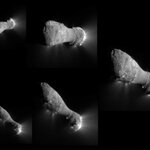
Using HiFi, the Heterodyne Instrument for the Infrared on the Hershel Space Observatory, researchers found that the ice on a comet called Hartley 2 has the same chemical composition as our oceans. Both have similar D/H ratios - the proportion of deuterium, or heavy hydrogen, in the water. A deuterium atom is a hydrogen with an extra neutron in its nucleus.
This was the first time ocean-like water was detected in a comet.
"…
Space
Where would we be without relativity? Observations in astronomy are based on light emitted from stars and galaxies and the light will be affected by gravity, according to the General Theory of Relativity, which is actually quite special, despite its name.
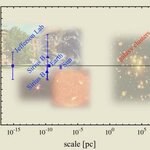
Observations are one thing, but interpretations in astronomy are based on the correctness of the theory of relatively, yet it has never been possible to test Einstein's theory of gravity on scales larger than the solar system.
Astrophysicists at the Dark Cosmology Centre at the Niels Bohr Institute say they have managed to get…
14 space agencies walk into a bar... Okay, no joke. The ISECG Initiative (I added 'Initiative' because it sounds more sci-fi) is an attempt to basically let individuals at different science institutes share information. Given the strength of Intellipedia and perhaps even Wikipedia, it seems info sharing might be the way to go.
The 14 agencies are:
ASI (Italy), CNES (France), CNSA (China), CSA (Canada), CSIRO (Australia), DLR (Germany), ESA (European
Space Agency), ISRO (India), JAXA (Japan), KARI (Republic of Korea),
NASA (United States of America), NSAU (Ukraine), Roscosmos (…
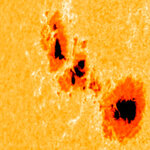
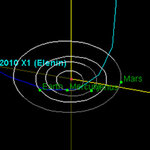
In Doomsday Comet Elenin Goes Out With A Whimper we dismissed concerns from prophets of doom that a tiny comet 22 million miles away would make any difference in our lives - but we never said anything at all about a sunspot and what it might due to your wireless PS3 connection at a crucial moment in "Gears of War".
Behemoth sunspot 1302 unleashed another strong flare on Saturday morning, an X1.9-category blast at 5:40 am EDT. NASA's Solar Dynamics Observatory (SDO) recorded the extreme ultraviolet flash.
The movie below shows a shadowy shock wave racing away from the blast site.…
Sonification-- like our Project Calliope satellite will do-- is taking the measurements of something and converting it to sound so you can hear the patterns and rhythms in an intuitive manner, rather than trying to figure out those patterns as numbers or graphs. It a way to remix data.
Apparently a TED talk discusses doing the opposite-- taking data and saying it is like sound. That's a step I'm not willing to take, but Janna Levin considers gravity waves a cosmological equivalent to sound. Err, okay? I suppose it's good enough for TED.
Alexebook #1 on Project Calliope…
2012 is coming and, with it, kooky end-of-the-world fables. If the Asgardian calendar and its earthquakes doesn't get us, maybe the Mayans will. Some people even like to combine Doomsday prophecies - the LHC might bring the end of the world by opening a black hole and out pop Mayans armed with strangelet-powered weapons.
In reality, the LHC couldn't hurt a fly with its energy (though I wouldn't stick my hand in it while it's LHC-ing, that could go to a weird place physically) and the Mayans had five calendars and they all restarted, as calendars do, so the end of this calendar to…
It took me several pages to examine what it will take for the US to address the pending space weather catastrophe, Brewster Rockit nails it in three panels:
Until next week,Alex
Tuesdays at The Satellite Diaries and Friday at The Daytime Astronomer (twitter @skyday)
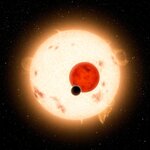
A terrific scene in "Star Wars" - when "Star Wars" universe was still good(1) - was the double sunset on Tatooine. It wasn't the first time it was done but the graphics in "Star Wars" were light years ahead of its competition. Well, parsecs ahead of their time, if you understand physics the way George Lucas did (2).
We may now get to think about what it's like for real, though no one lives on the newly discovered cold and gaseous planet, Kepler-16b in the Kepler-16 system, which orbits two stars.
Previous studies have found hints of planets orbiting binary stars, but…
I've talked about how our Project Calliope picosatellite will burn up entirely upon reentry. Larger stuff, not so easy. UT reports in the cutely titled "Look Out Below!" that the 6-ton URAS is going to reenter, messily, this Fall.
“Satellites re-entering is actually very commonplace,” Johnson said.
“Last year, for example, we averaged over one object per day falling
back uncontrolled into the atmosphere,” and for those coming back in an
uncontrolled fashion – meaning it is a crapshoot when and where they
fall — there were 75 metric tons of spacecraft and rocket bodies
falling back…
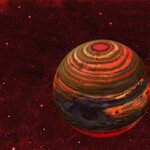
Extreme brightness changes on a nearby brown dwarf dubbed 2MASS J21392676+0220226, or 2MASS 2139 for short, may indicate a storm grander than any seen yet on a planet. Because old brown dwarfs and giant planets have similar atmospheres, this finding could shed new light on weather phenomena of extra-solar planets.
As part of a large survey of nearby brown dwarfs, which occupy the mass gap between dwarf stars and giant planets, scientists used an infrared camera on the 2.5m telescope at Las Campanas Observatory in Chile to capture repeated images of 2MASS 2139 over several hours.…