Space

Article teaser image

Desert Fireball Network Makes A Rare Meteorite Discovery

Meteorites discovered with known orbits are incredibly rare but researchers using cameras which capture fireballs streaking across the night sky have managed to find not only a tiny meteorite on the vast Nullarbor Plain, but also mathematically determine its orbit and the asteroid it came from. The ability to track meteorites back to their asteroid home also means it is an incredibly cheap way of sampling that asteroid, rather than conducting an expensive space mission. To find the meteorite, the team deployed three 'all sky cameras' on the Nullarbor Plain to form a fireball camera network.…
Article teaser image

A Mathematical Explanation For Gamma Ray Bursts

Black holes are invading stars, according to a new hyposthesis for the origin of the bright flashes in the universe that are one of the biggest mysteries in astronomy today.  Those flashes, known as gamma ray bursts, are beams of high energy radiation produced by jets of plasma from massive dying stars.   The current model for these cosmic 'jet engines' involves plasma being heated by neutrinos in a disk of matter that forms around a black hole, which is created when a star collapses.  Mathematicians at the University of Leeds have a different explanation; the jets come…
Article teaser image

Evidence For Atmospheric Water Loss On Venus

There is new evidence that the solar wind has stripped away significant quantities of water from Venus.   The SPICAV and VIRTIS instruments carried by the Venus Express spacecraft have been used to measure concentrations of water vapor in the Venusian atmosphere at altitudes ranging from the lowest 10 km up to 110 km, high above the cloud tops. Studies led by scientists from Belgium and Russia have found that the ratio of heavy water, which contains the isotope deuterium instead of hydrogen, to normal water is nearly twice as high above the clouds compared to its value in the lower…
Article teaser image

MIT Students Take Pictures from Near-space for $150

Take two students from MIT; now, take two students from MIT with only $150 in their pockets and a notion to use a little science to make a little art, and what do you get? ... Eight gigabytes of near-space photographs and an experience to share to the rest of the world of citizen scientists! Oliver Yeh, Justin Lee, and Eric Newton set out to take some amazing pictures, and they didn't have much cash to get the job done. So, with a lot of ingenuity, a little scrounging around the dorm room, they were able to create a secure -- and legal -- launch vehicle that contained a used Canon A470 camera…
Article teaser image

M31 And Ultraviolet Andromeda

NASA's Swift satellite has acquired a new high-resolution view of a neighboring spiral galaxy; M31 in the constellation Andromeda, the largest and closest spiral galaxy to our own. M31, also known as the Andromeda Galaxy, is more than 220,000 light-years across and lies 2.5 million light-years away. On a clear, dark night, the galaxy is faintly visible as a misty patch to the naked eye. Between May 25 and July 26, 2008, Swift's Ultraviolet/Optical Telescope (UVOT) acquired 330 images of M31 at wavelengths of 192.8, 224.6, and 260 nanometers. The images represent a total exposure time of 24…
Article teaser image

NASA Needs Amateur Astronomers to Observe Moon Crash

Last year, we featured on DPR AmSci, NASA's LCROSS Mission to the moon (read), which is an important study to see if water ice exists on the moon. A successful find would amount to a critical discovery that will lead the way for sending humans back to the big rock in the sky. An exciting feature of this mission is that NASA is soliciting the assistance for amateur astronomers to watch the crash -- and the resulting plume of moon dust -- from their backyards, and report their photographs and observations directly to NASA. The time is nearing for the event, which is scheduled for October 9, and…
Article teaser image

To Space: Burn, Armadillo, Burn!

What do engineer Burt Rutan, hotel magnate Robert Bigelow, and game programmer John Carmack have in common? Answer: they've built the first private earth-to-space rocket, space station, and lunar lander in the current new space race. Most people are familiar with Scaled Composite's X-Prize $10 million victory with SpaceShipOne, the first private reusable multi-flight manned spacecraft to succeed. But note 'first'-- they were not the only competitor. Just the first tick on the space race radar. Earlier, Bigelow Aerospace had put not one but two inflatable space stations into orbit now. Genesis…
Article teaser image

Going to space cheaper than me

Just how much would you pay to go into space? $12000 for a satellite plus launch, like me? Or perhaps... $300 to build a high-altitude balloon camera? Or, if $300 is too high, how about getting a couple of high school kids to do it for half that? Their 99EU ($144) high altitude balloon is a great achievement in engineering, science, cost reduction, and learning. Their hardware specs are, alas, not in the article, but some MIT students replicated their work at the same $150 price point. To space, Alex, the daytime astronomer Track The Satellite Diaries via RSS feed and Twitter @skyday
Article teaser image

New Radiation Belt Discovered Around Saturn

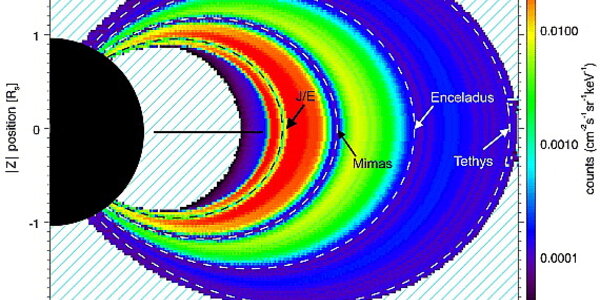
The Cassini spacecraft's Magnetospheric Imaging instrument (MIMI) has detected a temporary radiation belt around Dione, one of the moons of Saturn.  The discovery will be presented at the European Planetary Science Congress in Potsdam by Dr Elias Roussos on Monday, September 14th. Radiation belts, like Earth’s Van Allen belts, have been discovered at Jupiter, Saturn, Uranus and Neptune but it has only been possible to observe the variability of their intensity at Earth and Jupiter.   Cassini has been orbiting Saturn for more than five years so it has been possible to assess changes…
Article teaser image

Are The New Hubble Images Better ?

New beautiful images from the Hubble Space Telescope (HST) have been released recently, and they are, as always, a pleasure to behold. The HST was serviced in a mission by the Space Shuttle Atlantis crew last May, to replace some broken gyroscopes and drained batteries, and perform a number of additional important tasks that will allow operation to continue for many years to come. Among the new installed instruments the new HST sports an improved wide field camera, WFC3, which promises a significant improvement of the quality of telescope's imaging capabilities. As an example of the harvest…