Space

Article teaser image

Galaxy Evolution - An 8 Billion Year Pattern Emerges

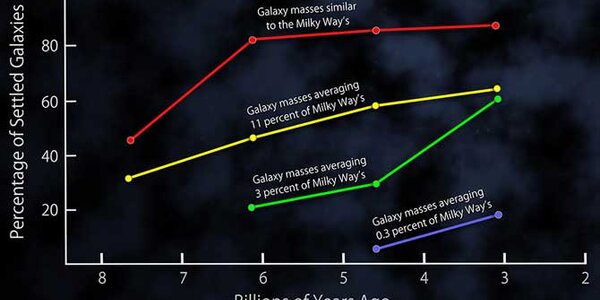
Star-forming galaxies take the form of orderly disk-shaped systems, like the Andromeda Galaxy or the Milky Way, where rotation dominates over other internal motions. The most distant blue galaxies in the study tend to be very different, exhibiting disorganized motions in multiple directions. There is a steady shift toward greater organization to the present time as the disorganized motions dissipate and rotation speeds increase. These galaxies are gradually settling into well-behaved disks. Blue galaxies -- their color indicates stars are forming within them -- show less disorganized motions…
Article teaser image

NGC 660 And A Rare Polar-Ring Galaxy

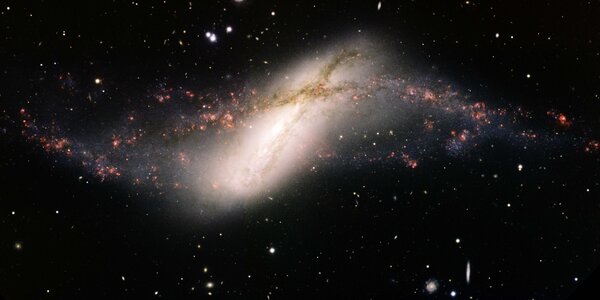
A Gemini Legacy image has captured the colorful and dramatic tale of a life-and-death struggle between two galaxies interacting. All the action appears in a single frame, with the stunning polar-ring galaxy NGC 660 as the focus of attention.  Polar-ring galaxies are peculiar objects. Astronomers have found only a handful of them, so little is known about their origins. Most have an early-type spiral system, called a lenticular galaxy, as the central showpiece, but NGC 660, which lies about 40 million light-years distant toward the direction of Pisces the Fishes, is the only polar-ring…
Article teaser image

Radioactive Titanium In Supernova Remnant 1987A

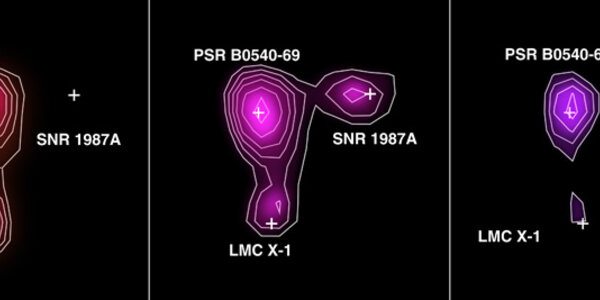
Supernova 1987A in the Large Magellanic Cloud was close enough to be seen by the naked eye when its light first reached Earth in February of 1987.  During the explosion's peak, fingerprints of elements from oxygen to calcium were detected, representing the outer layers of the ejecta and soon after, signatures of the material synthesized in the inner layers could be seen in the radioactive decay of nickel-56 to cobalt-56, and its subsequent decay to iron-56.  After more than 1000 hours of observation by Integral, high-energy X-rays from radioactive titanium-44 in supernova remnant…
Article teaser image

Life as we don't know it on a planet like Alpha Centauri B's nearest ?

How would we recognize truly alien life on a planet that is probably like a half molten Venus, and why we don't even bother trying.  How could we detect any kind  life on any extrasolar planet at all?    Given what we know about chemistry, astronomy, and physics we can say plenty about extrasolar planets.  We can even have informed scientific opinions or the presence or absence of life as we know it on such planets.   Why can't we say anything about life as we don't know it?  To understand…
Article teaser image

Discovery: An Earth-Mass Exoplanet Orbiting Alpha Centauri B

A planet around the mass of the Earth has been found, orbiting a star in the Alpha Centauri system; the nearest to Earth and also the lightest exoplanet ever discovered around a star like the Sun. Alpha Centauri is one of the brightest stars in the southern skies and is the nearest stellar system to our Solar System, only 4.3 light-years away. It is actually a triple star — a system consisting of two stars similar to the Sun orbiting close to each other, designated Alpha Centauri A and B, and a more distant and faint red component known as Proxima Centauri.  The components of a multiple…
Article teaser image

Like Diamonds? 55 Cancri Super-Earth Could Be A Girl's Best Friend

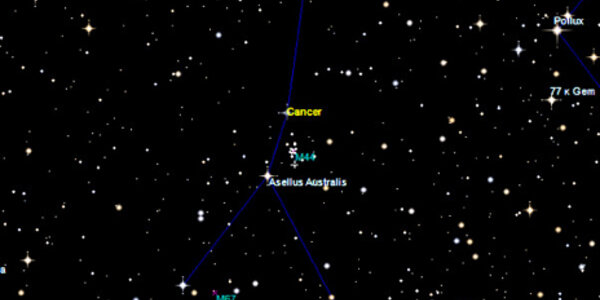
A rocky planet twice Earth's size, called 55 Cancri e, that orbits a nearby star is likely a diamond planet, according to new research. 55 Cancri e has a radius twice Earth's and a mass eight times greater, making it a "super-Earth." It is one of five planets orbiting the sun-like star, 55 Cancri, that is located 40 light years from Earth yet visible to the naked eye in the constellation of Cancer. The planet orbits at hyper speed; its year lasts just 18 hours, in contrast to Earth's 365 days. It is also blazing hot, with a temperature of about 3,900 degrees Fahrenheit, researchers said…
Article teaser image

Pulsars Could Cut Out The Middle Man For Interstellar Travel

Is it feasible to use dead stars to navigate spacecraft in deep space? Long-term space travel may be a pipe dream outside science fiction math but people inside science are at least thinking about how to make navigation possible.  Spacecraft navigation currently relies on radio transmissions between the craft and a network of ground-stations on Earth. This means that the craft has to wait for an instruction from Earth to guide it through space and with the large distances involved this could take hours, days or even longer - not really practical if we are going to Alpha Centauri. Even…
Article teaser image

Space Travel: Pioneer Anomaly Solved?

The 100 Year Spaceship Symposium, an international event advocating human expansion into other star systems, has some crucial hurdles to overcome. Basically, interstellar travel will depend upon extremely precise measurements of every factor involved in the mission, which isn't possible yet.  But a University of Missouri researcher thinks he has found the solution to a puzzle that has stumped astrophysicists for decades. The Pioneer spacecraft, two probes launched into space in the 1970s, seemed to violate the Newtonian law of gravity by decelerating anomalously as they traveled, but…
Article teaser image

Thor’s Helmet Nebula Gets Close-Up During ESO 50-Year Celebration

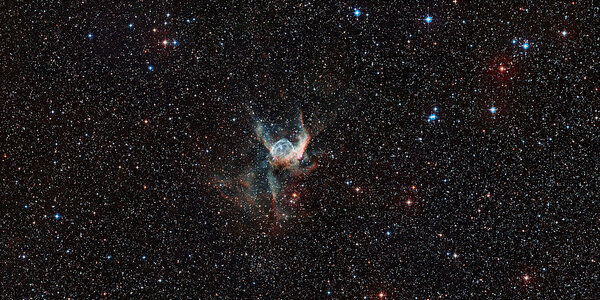
The European Southern Observatory (ESO) is officially 50 years old today and this morning, for the first time ever, observations with ESO’s Very Large Telescope were made of an object chosen by the public. The winner of an anniversary competition pointed the VLT towards the spectacular Thor’s Helmet Nebula and the observations were broadcast live over the Internet.  The signing of the ESO Convention on October 5th, 1962 and the foundation of ESO was the culmination of the dream of astronomers from five European countries; Belgium, France, Germany, the Netherlands and Sweden. They had…
Article teaser image

Sagittarius Discovery: S0-102's Blazing Fast Orbit Around The Milky Way's Black Hole

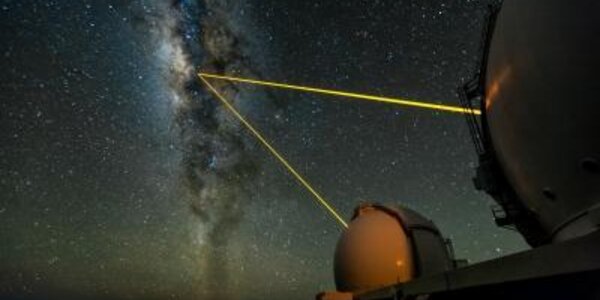
Black holes may not be so dangerous to stars after all. The discovery of a star named S0-102 may help reveal whether Albert Einstein was right in his fundamental prediction of how black holes warp space and time - it orbits the enormous black hole at the center of our Milky Way galaxy in a blazing 11.5 years.  Black holes, which form out of the collapse of matter, have such high density that nothing can escape their gravitational pull, not even light. They cannot be seen directly, but their influence on nearby stars is visible and provides a signature. Einstein's theory of general…