Physics
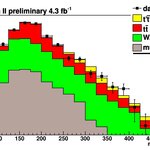

What picture should we draw of the quest for new phenomena after the presentation of a wealth of new results at the international conference on high-energy physics in Paris held last week ? I am speaking in particular of results coming from the experiments at the Tevatron and LHC, which are all studying hadron collisions in search for still unseen effects to both confirm (with the discovery of the Higgs boson) or break down (with the observation of Supersymmetry, new particles, extra dimensions, or still other effects) the present theoretical understanding of fundamental physics which the…

Imagine you are tasked to build the ultimate computer memory. You are provided with an unlimited budget and all the resources you need.
How big a memory capacity could you build?
You decide to put it to a test. Being a clever cookie, you don't just order a huge pile of computer memory chips. You know you can do far better than relying on standard components. So you start designing and building ultra high density storage devices: high energy modules each capable of storing an insane amount of information. Soon you have set up a manufacturing line for these memory devices, and you…


Simmulating aspects of the big bang in a particle accelerator through the coulomb explosion of a sufficiently dense bundle of fundamental particles could be practical and informative.
Suppose a team of particle physicist figure out a way to get a bunch of protons in an accelerator up to a energy density of 0.1 or 0.2 of the Planck density. Then observed the coulomb explosion of this bundle of particles. Less than a second after the big bang the whole universe would have been a soup of elementary particles at those kind of densities. What…
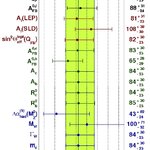
After the issuing of new top mass results by the Tevatron experiments, it is time for another look at global electroweak fits of standard model observables. The Gfitter group has produced new fits for the standard model in search of the most probable value of the Higgs boson mass, given the new measurements of top quark mass and other quantities, and the huge amount of existing information on sensitive observables from the standard model.
Unfortunately, I could find no update including the new Higgs search results yet. I guess such a fit will be ready in a few weeks... But the new released…
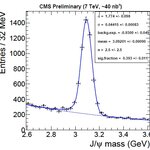
While the focus of the international conference in high-energy physics in Paris last week has been on the search for new physics and the precise measurement of standard model quantities, I will offer to you today something more technical, but in no way less physics-rich; it was presented in Paris, but with the many parallel sessions it may have well gone unnoticed... What I wish to explain to you is the procedure by means of which the CMS experiments calibrates the scale and resolution of its charged particle momentum measurement.
The dull sound of the topic as stated above should not deceive…

Werner Heisenberg's 'Uncertainty Principle'(1927) is a fundamental concept in quantum physics, basically saying you can be increasingly accurate in position or momentum (mass X velocity), but not both(1). This can be an important feature rather than a defect in something like quantum cryptography, where information is transmitted in the form of quantum states such as the polarization of particles of light.A group of scientists from LMU and the ETH in Zurich say they have shown that position and momentum can be predicted more precisely than Heisenberg's Uncertainty Principle states - if…

While everybody is busy discussing the latest Tevatron results on the Higgs boson searches -is that the light-mass excess the internet was abuzz, is it consistent with a signal as we expected it, how long will it take to confirm it is not a fluke, etcetera, etcetera, etcetera- I think I have a different plot with which to enthuse you.
If you do not like the figure below, courtesy CMS Collaboration 2010, you are kindly requested to leave this blog and spend your time reading something else than fundamental physics. I do not know what will ever make you believe particle physics is beautiful,…

Dynamic quantum logic
Abstract
Quantum logic has the structure of an orthomodular lattice. This defines a static skeleton. There is nothing in QL that restricts dynamics. There is also nothing that withholds dynamic events of occurring within this skeleton. There is a need to add axioms to QL that convert it into a suitable dynamic quantum logic. It appears that inertia offers a useful guidance on how to proceed.
Logic
There exist several types of logic. One of them is classical logic. It is well known, then its structure is rather simple and can be visualized with Venn diagrams. It is the…
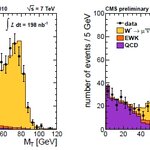
The parallel sessions at the international conference on High-Energy Physics in Paris are over, and it is time for a summary of results. Of course if you are following the conference you will get it from the summary talks, but if you prefer some armchair, remote attendance of the conference, I have collected for you a few meaningful plots.
Here I wish to assemble some of the electroweak physics results produced by CMS in time for ICHEP. The CMS experiment has shown results that use up to 280 inverse nanobarns of proton-proton collisions, but for electroweak measurements -those involving W…
I thought that I knew what a unitary transform is, until I started thinking about it.(2^n-ons are hypercomplex numbers that are related via the 2^n-on construction. Including n=3 the 2^n-on construction gives the same numbers as the Cayley-Dickson construction. From there the 2^n-ons are "nicer".)
I know the following:
· Unitary transformations are special kinds of normal transformations.
· In Hilbert space unitary transformations have eigenvectors that together form an orthogonal base of the Hilbert space.
· The eigenvalues are unit size numbers.
· They leave inner products of…