Physics


Ashay Dharwadkeris the founder and director of the Institute of Mathematics, Gurgaon, India. He is interested in fundamental research in mathematics, particularly in algebra, topology, graph theory and their applications to computer science and high energy physics. Based upon the new proof of the four color theorem, he has developed a grand unified theory for the Standard Model and gravitation. In particular, this leads to a mathematically precise prediction of the Higgs boson mass. Vladimir Khachatryan is a member of the Institute of Mathematics, Gurgaon, India and a PhD student at the…
While a thousand physicists gather in hot Paris and listen to talk after talk, I am confined in a small island of the Mediterranean, trying to relax and gather my ideas for the next few aggressive months of data analysis, a course of subnuclear physics in the fall, and of course, more reckless rumor-mongering!
Being away from the scene where the top HEP physicists are discussing does make me a less-than-well-informed source, but it also yields some advantages. No, I am not talking of the blue waters of Elafonisos (see right), of the fish dinners on tables planted on the sand of a beach, or of…
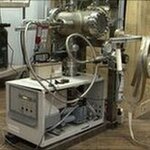

Mark Suppes' Fusion Reactor
In 2008, DPR discussed the emergence of an extreme case of amateur research [READ more] where a growing number of independent citizens (see the list) are developing working fusion reactors at home.
An emphasis is on the extreme here as a citizen science project, since the financial requirements are high (an understatement, for sure). Although the actual process of low-scale fusion in a properly sealed chamber is reasonably safe (in particular, there is low radiation and no nasty nuclear waste left over to throw away), high voltages are required and an advanced…
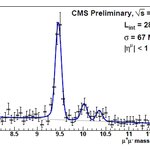
The CMS collaboration at the LHC collider has just produced its very first results on the production of Upsilon particles, with 280 inverse nanobarns of proton-proton collisions at 7 TeV center-of-mass energy. I wish to discuss these results here, to explain what is interesting in these very early measurements, and what we can expect to learn in the future from them.
The production of resonances decaying to muon pairs is one of the first things one wants to study when a hadron collider starts operation. This is because these particles are extremely well known, so one immediately figures out…

I am preparing a disclaimer to be added to the bottom of my posts here. The problem I am trying to solve -at least in part- is that the colleagues in the scientific collaborations I work for apparently fear that I be identified, by science reporters or other media agents, as an official source of information from those experiments.
To understand the problem you should know a few things about the way scientific collaborations allow the distribution and discussion of their results. In order to be able to represent a large collaboration at a scientific conference your talk slides, as well as…
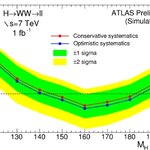
The Atlas collaboration made public, just in time for the 2010 ICHEP conference in Paris, the projected reach of their searches for standard model Higgs bosons. This is a whole set of interesting new results which, although necessarily still based on simulations, tell us a lot about what we might see toward the end of next year at the LHC.
Here I will just flash a couple of the results, because the plentiful online documentation that ATLAS provided makes it a worthless exercise on my part to just echo it here. However, maybe I can comment the most relevant plots for those of you too lazy to…

So, now we know. There is no 3-sigma signal from the Tevatron.... Sure, because they have not combined their MSSM searches yet!
Crucification
I will spend little time here discussing the various colourful ways by means of which I have been depicted:
- unreliable source of information- fame-seeking blogger- Paris Hilton of Physics- Less trustworthy than Paul the Octopus- and I could go on, but I prefer to leave these envious utterings where they first diffused their stench.
I am amused by the attention, but rather disappointed by the utter failure of all these commentators to understand what…
Prayer to the Funding Agency Reviewer(dedicated to those who worry about the detrimental effect of rumours)
Oh Funding Reviewer, on whose handsRests the destiny of full many an experiment:Be true to yourself, and bias notThy sober judgement through the browsingOf tricky sites or malicious magazines.
You were chosen, wise among the wise,To distribute thy moneys to the worthy.Human knowledge is at the stake:Neglect the rumours, and listen not To lesser souls. Let the Science be your guide.

Funny. While dozens of online media are abuzz with the (non)-news, and while Fermilab Today tweets that there is no Higgs in store for us and a blogger in search of fame is just spreading unconfirmed voices which have no foundation, Lubos Motl over at the Reference Frame gets more detailed rumors on the same thing, and that does make things a bit more interesting.
Even more funny is to know that exactly a month ago yours truly discussed a new CDF result on MSSM Higgs bosons which showed a deviation of over two standard deviations, explainable in terms of a Higgs boson with mass of about 150…
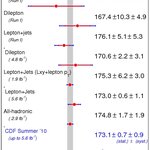
The CDF experiment has just released their new average of top quark mass measurements, obtained with analyses that use up to 5.6 inverse femtobarns of proton-antiproton collisions provided by the 2-TeV Tevatron collider: the new measurement is M(top) = 173.1 +- 0.7 (stat) +- 0.9 (syst) GeV, a measurement with a total uncertainty of 1.3 GeV, or 0.75%!
Have a look at the various measurements that enter the calculation in the graph below.
I will never get tired by mentioning that the top mass is astonishingly close to the original measurement performed in 1994 by CDF, at a time when the…