Physics

Those working on quantum gravity have to accept the fact they are unlikely to ever compete for a Nobel in physics. No matter how brilliant and how widely accepted the contribution, a Nobel prize in physics is not awarded as long as the work has not been verified experimentally. I am not sticking my neck out very far when I predict that a direct detection of quantum gravity effects will not happen before the end of this century. And as Nobels don't get awarded posthumously, the Hawkings of this world have to put their hopes on alternative prizes that are less focused on experimental…


I just ask. If I look at a glowing something with an antenna, I will not get any signal, I think. This is, I believe, because the radiation comes as photons, more or less, because it is a result of thermal motion. Each of the myriads of electrons in the glowing material moves independently and each emits the energy as a photon. The antennas can not see photons. They can see only electromagnetic waves.
To get electromagnetic waves, I must have an ordered motion, some oscillating current of some kind. In the optical region of frequencies we have lasers which also produce coherent…
 vongehr |
Often when reading about cutting edge physics and the amazing feats of the Large Hadron Collider, we are treated to crazy scenarios involving “virtual particles”, also variously referred to as “ghost particles” or worse. These labels clearly distinguish the involved concepts from "real particles" like atoms. Not being bound by restrictions of reality, virtual particles “borrow” energy from nothing, go faster than light, travel back in time, do an infinite amount of loops creating an infinity of other virtual particles during every single infinitesimal moment.
For some examples of this…

The 6 minute YouTube video, available in high def, provides a walking tour of my private Pop Science art collection. One painting spent a summer month in Lancaster, PA as part of a juried show. "Turquoise Einstein" was a hit with the public, but did not win "Best in Show" because it was too happy. Happy art is not serious art.
Most of these piece were created around 1995. Each piece was driven by equations I was pondering about in physics. The math is right, wrong or I don't understand it, but at least it looks good.
The big take home message I want people to get concerns patience.…
 Anonymous |
I had a new computer simulation.
We set up each model from the birth of universe to the present, and calculated GPE using computer simulation in each level.
As a result, we could verify that “pair creation model of negative mass and positive mass” explains inflation of the early universe and decelerating expansion, and present accelerating expansion in time series.
This simulation is showing incredible results.
It not only explains the total energy of the universe, flatness, and the essence (Total zero energy, pair creation of negative energy and positive energy) of the process of birth…
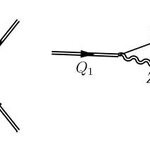

Of the dozens of new physics models which are currently on the market of Standard Model extensions and plug-ins, the ones hypothesizing the existence of additional dimensions of space-time beyond the 3+1 we know about are definitely among the most fascinating.
Imagine what a discovery would be, if we found out that our senses do not really represent any faithfully the reality in which we are immersed. I could hear the tumult from astrologists, occultists, ufologists, sellers of pseudoscience: "Aha! See, there's more than meets the eye!". We would instantly get flooded by ex-post…
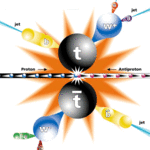
A new result by the CMS collaboration has been produced today on top quark physics. For those of you who only get triggered by the search of new particles or new forces, the study of "yesterday's signals", such as top quarks, is boring and uninformative; but high-energy physics is a rich field of research, and we extend our understanding of subnuclear physics no less by getting to know how exactly top quarks get produced in proton-proton collisions, than we do by placing limits on ephemeral particles (SUSY ones, e.g.).
So I salute the new measurement as an important advance. Using over one…
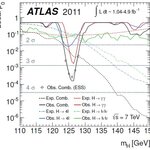
You have seen it already two months ago, but those were "preliminary" results. Now both CMS and ATLAS have produced full-fledged documents (CMS here, ATLAS here) describing their respective combinations of different Higgs boson searches, using data collected in 2011 by the two experimental apparata at the CERN Large Hadron Collider.
So what - you might retort - these are still "unpublished", in the sense that they have not seen the light of printed matter on scientific publication; they still only exist in the form of preprints. Let me clear the ground from misunderstandings here: between…
I spent the week seeing if I could give the good old college try and find a "way that worked" for the gauge games I have been playing. Nothing panned out. Bummer, I had a blog to write. While collecting crumpled paper, there was an old issue I wasn't able to figure out. The answer was probably known a hundred years ago. The blog will explain where I got stuck, and who knows, maybe someone will provide the answer.
In my previous blog, I focused on the fields, the derivatives of the potential. In the comments, CuriousReader pointed out that careful thought had to be devoted to the interaction…


Happy 2012 ! I had not been writing any post in this blog since last October. Furthermore, my first article was not devoted to my own work of this period discussing the OPERA result on a possible superluminal neutrino. See my articles Comments on the recent result of the "Measurement of the neutrino velocity with the OPERA detector in the CNGS beam" (September 28) and Astrophysical consequences of the OPERA superluminal neutrino
(September 29).
The first of these two papers was previous to that by Andrew Cohen and Sheldon Glashow (September 29), and it already raises the question of…