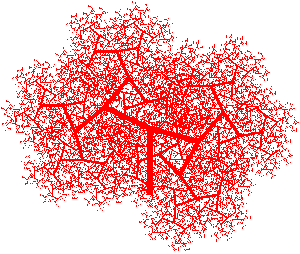
The science of Chaos is usually defined as the systematic study of non-linear processes within dynamic turbulent systems (see www.hesiodproject.net). Vivid examples of such systems are: the global economy and the global crisis, wars and armed conflicts, human beings and social organizations, the stock market, science and technology, the Olympic Games, football games and other sport events, the weather systems, the internet, World Wide Web, Web 2.0, journalism and journalism 2.0, etc.
Chaotic systems are intriguingly rule-based; they are both deterministic and unpredictable at the same time. It rather seems that there is always a permanent undecidable tension (as well as a paradoxical demiurgic compatibility) between unpredictability and determinism, between contingency and directionality.
On the one hand, social institutions, networks and structures are inherently fragile, unstable and contingent because choice, imagination and improvisation are ubiquitous and esoteric in each and every individual and collective action. There are always new alternate (and unanticipated) roads to fruitful collaboration, innovation and creativity. The future is actually open, subversively enigmatic and potentially full of surprises (for better or for worse...).
On the other hand, a systematic, well-informed and carefully detailed historiographical approach can easily demonstrate persistent (hidden) patterns and trends underlying the relative “directionality” of social and political change and evolution.
Notions of “path dependency” now seem very relevant and realistic, so that they get seriously re-energized and re-introduced to the context of analysis. Common global developments are thus far from purely erratic and arbitrary, but still unpredictable in the long run (i.e. beyond the so-called predictability horizon).
We therefore need to deeply and radically challenge and revise the old conventional ways of perceiving and conceiving the increasingly pluralized “post-human” social and historical universe.