
Air India Crash: When 2 + 2 Does Not Compute
2 + 2 Does Not Compute, But 1 of 3 AND 1 of 3 Does
On 12 June 2025 a Boeing 787-8 Dreamliner crashed shortly after takeoff from Ahmedabad Airport, India. The crash resulted in the tragic loss of 248 lives. The plane was destroyed, along with a number of buildings. There was only one surviving passenger.
Why investigate when you can blame the pilot or pilots?
Throughout the whole history of civil aviation there have been far more instances of defects in the plane causing a crash than pilot error. There are but very few instances of a pilot deliberately causing a crash.
Here is a question in the form of a puzzle. There are two pilots in a plane's cockpit and two fuel cutoff switches which can only be moved by human hands. We know that the fuel was cut off. How was the fuel cut off?
Many people will jump to the conclusion that 2 pilots plus 2 switches equals deliberate human action. The typical reader of science 2.0 however will reply in the manner of Isaac Asimov's Multivac computer: "Insufficient data for a meaningful response.". The preliminary report from India's Aircraft Accident Investigation Bureau does not compute: there is insufficient data for a meaningful discussion of how the accident might have been caused.
The report, for reasons known only to its authors, fails to mention the four per engine fuel cutoff switches / relays. Only one of the four is under the control of the pilots. Indeed, the AI 171 pilots may not even have known of their existence.
"It is hard to imagine a text more likely to sow confusion and encourage speculation than the partial summary of the fate of the Boeing 787 in Ahmedabad" The Times, India.
When 2 + 2 Does Not Compute.
Immediately following news of the crash there was speculation across social media as to its cause. There was an unfortunate element of racism in many comments, with people overly ready to blame pilots, maintenance, managers and others based solely on the fact that they were Indian. Judging by comments left on YouTube, the majority in the court of public opinion seek to blame the pilots. After all, those switches don't move themselves. But the other fuel cutoff switches, actually relays, are not mentioned in the interim report. Were they deliberately hidden from view? Or were the investigators incompetent?
The fact that the pilots had been condemned in the court of public opinion made the task of the authors of the interim accident report so much easier. The report does not blame any person or any thing. It merely states, in effect: "Look at these two switches which can only be moved by human hands". Also: "Look at these two humans". There are many gaps in the report, leaving too many things to the reader's imagination. But the report does not directly blame the pilots. As a matter of plausible deniability the authors made sure to not directly blame the pilots. But through classic misdirection such as is used by magicians they made sure that the public would infer that the report blames the pilots. Absent the exercise of due diligence almost anyone would blame the pilots. And many newspapers, Youtubers, media influencers and commenters did. But not for those for whom nullius in verbam is a thing.
Due diligence is not a hard task, or a big ask, in this age of the internet. Information about almost anything is "out there". Seek and ye shall find. There is more than sufficient information on the web for the Air India pilots to be exonerated in the court of public opinion.
There is an old saying: "A little knowledge is a dangerous thing.". People with knowledge of how planes generally work may not know about how MEA specifically works and may thus look at this accident from the limited perspective of their own knowledge and experience. That way lies error. MEA - More Electric Aircraft - is a method of improving performance of aircraft in terms of fuel economy and weight saving. MEA replaces metal rods and cables with sensors and electronically controlled actuators. Digital MEA replaces heavy analog (current carrying) actuator power cables with lighter digital signal carrying cables. Digital signals from sensors - which includes pilot controls - operate relays (whether mechanical or solid state) which feed power to actuators.
In the Boeing 787 series almost everything is digitally controlled through electronics and computers. Each engine is controlled by an EEC, an Electronic Engine Controller, sometimes called an ECU, Engine Control Unit. The 787 engines are controlled by a type of EEC called a FADEC. This is a Full Authority Digital Engine Controller. Full Authority means exactly what it says: this computer is autonomous. It has full control over the fuel supply to the engine.
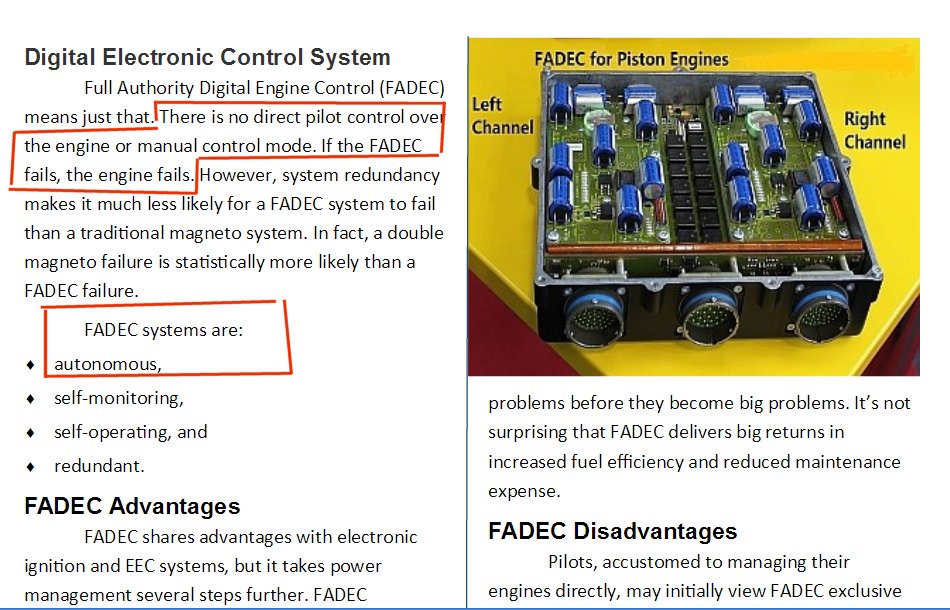
img of FADEC text
The TCMA has full control over fuel cutoff
In addition to the FADEC there is a TCMA - Thrust Control Malfunction Accomodation system. The TCMA has full control over fuel cutoff. That is worth repeating again. The TCMA has full control over fuel cutoff.
Yes, there are also two toggle switches below the throttle levers, so the pilots have complete authority to shut off the fuel. But because of the TCMA system they do not have final authority to leave the fuel supply on. The TCMA system has two command modes: fuel on and fuel off. Unlike most switches such as household light switches, which simply open a circuit, the TCMA system and pilot's switches are changeover switches. Changeover switches close a second circuit when they open the first circuit. The 787 fuel system has two control lines common to the fuel cutoff relays and the pilots' switches. There are thus four sets of switching contacts wired in parallel, each of which can cut off the fuel.
TCMA img here
Although electromechanical logic has long since been replaced by digital logic in most fields, there is still a need for electromechanical devices such as relays and contactors. These have auxiliary contacts which signal the opening or closing of the main contacts. Either or both relay contact types can produce a fault condition.
A defect was discovered in the 787 fuel valves such that the fuel could not be shut off in the event of fire. The problem has been resolved by ensuring that the fuel valve actuators fail safe to a fuel off condition if an engine fire is detected. Presumable the one per engine fire switches are operated by relays.
For each engine there is one switch and three relays wired in parallel so that any one of them can cut off the fuel. Because they are wired in parallel it makes no difference if one, two or three switches are set to 'fuel on': if any one switch is set to 'fuel off' then the fuel will be cut off regardless of other switch settings. Computer buffs will recognise this as classic OR logic. The fuel can be cut of by any one of three contacts. There are two engines. Obviously the fuel to both can be cut off by the pilots. That's one condition. There are three relays on engines 1 and 2. Any relay alone can cut off the fuel to one engine. Any 1 of 3 on LH engine and any 1 of 3 on the RH engine can cause fuel cutoff on both engines. There are 9 possible ways to shut down both engines.
truth table img here
There is only one way the pilots can cut off fuel to both engines and nine ways for the automated system to cut off both engines. Given the 9 to 1 ratio it should be obvious that the plane's automated systems are far more likely than the pilots to have cut off the fuel. In the unlikely event that the fire switches are a manually operated redundant backup to the master fuel switches then the chances of automatic fuel cutoff would still be 3 out of 4.
A system fault becomes even more likely when one considers that it has happened before. Here are some examples with brief descriptions.
Uncommanded 787 fuel cutoff at Osaka.
In 2019 an All Nippon Airways (ANA) flight touched down on the runway at which point the Thrust Control Malfunction Accommodation System malfunctioned and cut the fuel to the engines.
FADEC Faults
3 items
1995 Boeing Chinook Loss
In 1994 a Boeing Chinook crahsed on the Mull of Kintyre. The initial reaction of the powers that be was to blame the pilot. It later transpired that there had been many problems with the FADEC.
Loadmaster
2019 Diamond DA42 Twin Star
Speyer, Germany. In March 2019 both engines on a DA42 Twin Star failed simultaneously as the pilot selected gear up. He was able to land immediately with no injuries. This was caused by a FADEC flaw which shut down both engines.
Pitch faults
2 x 737
2 x ???
The Physics Of Spooling Down And Zooming Up
Engine dynamics
RAT dynamics
img thrust drag lift weight
Glider dynamics
Conclusion
There is plenty of evidence that a systems failure is the most likely cause of the Air India 171 tragedy. There is no real evidence of pilot malice, only innuendo and selective presentation of facts. If the intention of the investigators is to claim malice then they will be glad of the help they are getting from the gutter press and from some people on social media. It is being reported that the captain's last words on leaving for the airport were: "How are you Mr Lokhande. Please, take care of papa." Innuendo, Implication.
The full quotation is: " ‘How are you Mr Lokhande. Please, take care of papa, and I will be back soon."
De mortuis nil nisi bonum dicendum est
Sources
A special tip of the hat to Flying Beast
https://www.youtube.com/watch?v=sDQHhlPGaoc
Ministry of Civil Aviation Press release
https://www.pib.gov.in/PressReleasePage.aspx?PRID=2139785
2025 - Fuel Shutoff Valve – Mandatory Actions on Boeing Aircraft
https://www.caa.co.uk/publication/download/25076
2015 - https://www.federalregister.gov/documents/2015/09/29/2015-24145/airworth...
Report on the accident to Boeing 777-222, registration N786UA at London Heathrow Airport on 26 February 2007
https://assets.publishing.service.gov.uk/media/542303bced915d1374000bbb/...
APPEAL TO PUBLIC AND MEDIA ON VT-ANB ACCIDENT
https://aaib.gov.in/What's%20New%20Assets/APPEAL%20VT-ANB%2017-07-2025…
Full Authority Digital Engine Control (FADEC)
https://www.faa.gov/sites/faa.gov/files/2022-01/Full%20Authority%20Digit...
TCMA - Thrust Control Malfunction Accomodation system patent
https://patents.google.com/patent/US6704630B2/en
2019 All Nippon Airways (ANA) flight fuel cutoff
https://www.financialexpress.com/business/airlines-aviation/ai-171-crash...
Multiple FADEC problems
https://en.wikipedia.org/wiki/1994_Mull_of_Kintyre_Chinook_crash
https://www.computerweekly.com/news/1280096803/Chinook-ZD576-How-the-Fad...
2015 Seville Airbus A400M crash - 3 of 4 engines shut off by FADECs
https://en.wikipedia.org/wiki/2015_Seville_Airbus_A400M_crash
2019 A dual engine failure in a Diamond Twin Star highlights the technical gotachas of FADEC-driven engines.
https://aviationconsumer.com/industry-news/fate-1-fadec-0/
https://en.wikipedia.org/wiki/SilkAir_Flight_185
https://en.wikipedia.org/wiki/China_Eastern_Airlines_Flight_5735
A reverse engineers perspective on the boeing 787 ...
https://www.ioactive.com/reverse-engineers-perspective-on-the-boeing-787...


