One of my favorite zoologist habits is to gesture on one's own body when describing an animal's anatomy. The weirder the animal, the funnier the implicit analogy.
"These worms have a ventral nerve cord," I explain, drawing a line from my collarbone to my navel. "This mollusc has gills on its dorsal surface," reaching over one shoulder to pat my back.
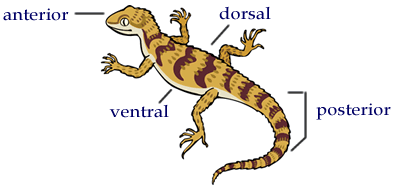
Easy to do in front of a class, harder on the printed page. There we rely on diagrams to indicate dorsal (top), ventral (bottom), anterior (front), and posterior (back). For example, here's a squid:

It's a beautiful drawing, isn't it? Full of character! But wait a minute. Who did the labels? That "posterior surface" is actually the ventral surface. The squid's funnel indicates its underbelly, the surface that faces down towards the seafloor.
A squid's true posterior (back-end*) isn't a surface so much as a tip--the tip with the fins, to be precise. That's at the very top of the drawing, just below the blue title bar. Do you know what makes the squid's anterior (front-end)? Yep, it's the other end, the one with all the arms and tentacles.
That means when a squid is jetting fins-first, which is the most aerodynamic and thus fastest way to swim, it is actually going backwards. Strange!
Anyone know who I should contact at HowStuffWorks to get this drawing corrected?
* I realize there is a linguistic ambiguity with the word "back", which we use colloquially to mean both posterior and dorsal. Humans are aberrant. Instead, consider this lizard: