
Throughout history, scientists, philosophers, mathematicians and Phd students lacking funding for actual research have turned to the thought experiment in hopes of discovering something publishable, thereby retaining tenure and/or attracting the admiration of comely undergraduates.
The best thought experiments throw light into dark corners of the universe and also provide other scientists, philosophers, mathematicians and destitute Phd students a way to kill time while waiting for the bus. Below is a classic thought experiment, pillaged from my book The Geeks' Guide to World Domination (Be Afraid, Beautiful People). I'll post a new thought experiment each day this week.
In 1949 the physicists Erwin Schrödinger and Albert Einstein got together to chat about reality. This led to a number of discoveries, among them the First Law of Physicist-Assisted Entropy, which states that “whenever two physicists get together to chat about reality, the total amount of reality (R) in the universe is decreased in direct proportion to the combined IQ of said physicists.”
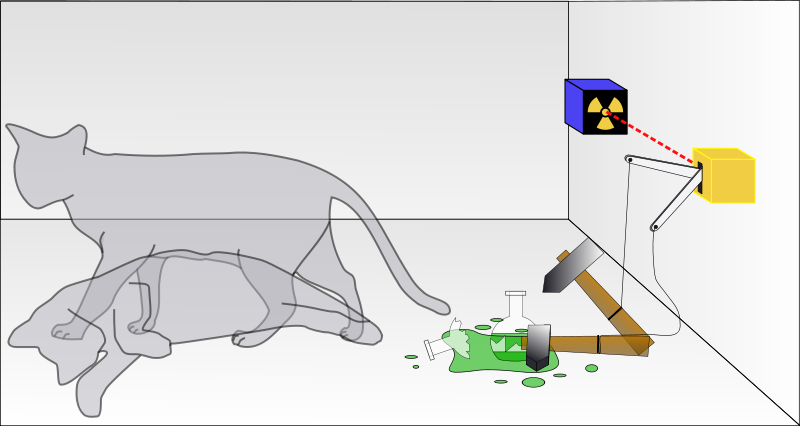
The FLOPAE was a product mostly of Schrödinger’s Cat, a thought experiment in which the feline in question was eventually pronounced both alive and dead at the same time (according to quantum physics…).
First, imagine a cat in a box. You can't see in and the cat can’t see out. What the cat can see is a rock, a Geiger counter and a vial of poison. Now, the rock is slightly radioactive, with an exactly 50/50 chance of emitting a subatomic particle in the course of an hour. If the rock emits a particle, the Geiger counter will flip a switch that breaks the vial of poison, killing the cat. (Note to PETA: thought experiment.)
At the end of the hour, from the point of an observer outside the box, is the cat alive or dead? Maybe both at the same time? Has this event generated one world in which the cat is alive and another world in which the cat is dead?
Physicist Stephen Hawking said, “When I hear of Schrödinger’s Cat, I reach for my gun.”


