The Carnival of Cosmology: Bloggers on Dark Energy is now up and running on Matthew R. Francis' Galileo's Pendulum:
In the spirit of blog carnivals, several of us—cosmologists, physicists, astronomers, and writers who just love all these subjects—decided to write about one of the abiding mysteries of modern cosmology. That mystery is dark energy, the name we give to the accelerated expansion of the Universe.
There are contributions from Ethan Siegel, Kelly Oakes (of Basic Space) interviewed Nobel Laureate Brian Schmidt, one of the astronomers who discovered dark energy, astronomy writer Desiree Abbott (Ms. Disarray) explains why white dwarf supernovas are a good way to measure the rate of cosmic metric expansion, and myself examining some of the reasons why people reject dark energy, including psychological factors, then defending the reasonableness of dark energy as a natural ingredient of general relativity.
Katie Mack writes on what we know about dark energy and how it constrains some of our more exotic theoretical suggestions. Those more exotic suggestions include phantom energy.
Matt's own contribution covers a lot of the same ground: what we know and don’t know about dark energy.
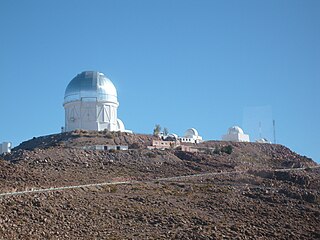
The Cerro Tololo Observatory in Chile, where dark energy was discovered, and where the Dark Energy Survey (DES) of over 300 million galaxies will be performed. (Picture and caption stolen from Galileo's Pendulum.)