
Test announcement

Announcement here about some event or update. Or maybe link to promoted article. 

Main navigation

  • Home
  • Culture
    • Humor
    • Mathematics
    • Random Thoughts
    • Science & Society
    • Sports Science
    • Technology
  • Earth Sciences
    • Atmospheric
    • Energy
    • Environment
    • Geology
    • Oceanography
    • Paleontology
  • Life Sciences
    • Ecology & Zoology
    • Evolution
    • Immunology
    • Microbiology
    • Neuroscience
  • Medicine
    • Aging
    • Cancer Research
    • Clinical Research
    • Pharmacology
    • Public Health
    • Vision
  • Physical Sciences
    • Aerospace
    • Applied Physics
    • Chemistry
    • Optics
    • Physics
    • Space
  • Social Sciences
    • Anthropology
    • Archaeology
    • Philosophy & Ethics
    • Psychology
    • Science History
  • Contributors
X X - place for social icons.

User menu

  • Log in

Uffington White Horse is actually a dog?

By Hank Campbell in Science 2.0
October 13, 2010
Profile picture for user Hank
Submitted by Hank on Wed, 10/13/2010 - 08:10
Old NID
72660

You may not know the name of the Uffington White Horse but you have likely seen it.   It's carved into the Oxfordshire hillside (Brits love to carve things into hillsides) and looks like a horse.

Except apparently there has been a recent to-do because the mystery critter might not be a horse at all, but instead a rather less majestic dog, says retired vet Olaf Swarbrick.
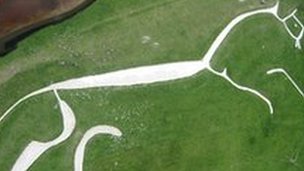
Uffington white horse oxfordshire

"Anatomically it's not a horse at all," Mr Swarbrick told the BBC.  "It's too long and too lean and it has a long tail - horses don't have a tail the length of that stylised creature at Uffington."

It's art, say proponents of the horse idea, not a literal representation of animal anatomy.  And it makes more sense to be a horse, since no one carves giant dogs into hillsides.   Though anyone who believes that because soil samples are 3,000 years old so that carving is 3,000 years old is likely to believe anything.

Donate

Please donate so science experts can write for the public.

At Science 2.0, scientists are the journalists, with no political bias or editorial control. We can't do it alone so please make a difference.

Donate with PayPal button 
We are a nonprofit science journalism group operating under Section 501(c)(3) of the Internal Revenue Code that's educated over 300 million people.

You can help with a tax-deductible donation today and 100 percent of your gift will go toward our programs, no salaries or offices.

Latest reads

Test for editor3
Test for editor3
Lorem ipsum dolor sit amet, consectetur adipiscing elit, sed do eiusmod tempor incididunt ut labore et dolore magna aliqua. Porta nibh venenatis cras sed. Pharetra massa massa ultricies mi quis…
No, Trump’s Executive Orders Can’t Cancel Your Rights.
Donald Trump does not have the power to rescind either constitutional amendments or federal laws by mere executive order, no matter how strongly he might wish otherwise. No president of the United…
The US Discourages Pregnant Women From Drinking Alcohol - Vegetarian Diets Are Worse
The Biden administration recently issued a new report showing causal links between alcohol and cancer, and it's about time. The link has been long-known, but alcohol carcinogenic properties have been…

More reads

Featured Image

Primary Liver Carcinoma May Be Misclassified Based Solely On Major Imaging Features

A study released in the July 2016 issue of the American Journal of Roentgenology found that biphenotypic primary liver carcinoma (also called hepatocholangiocarcinoma) may be misclassified as…
Featured Image

There Are Detectable Brain Differences Between Musicians And Non-Musicians

Music is in most aspects of our lives we probably don't even notice it - but it can be noticed in our brains.
Featured Image

Glue Isn’t Proof Of Neanderthal Intelligence - It Was Easy To Make

It was easy to make a strong adhesive in the Stone Age so claims about the presence of glue 50,000 years ago meaning higher intelligence for "Neanderthals" don't stick very well.
Featured Image

Why KID Syndrome Patients Experience Different Sets Of Symptoms

A team of New York-based researchers has compared the effects of two disease-causing mutations, potentially explaining why patients with the rare genetic disorder keratitis-ichthyosis-deafness (KID)…

Footer

  • About Us
  • Copyright and Removal
  • Privacy Policy
  • Terms