
Test announcement

Announcement here about some event or update. Or maybe link to promoted article. 

Main navigation

  • Home
  • Culture
    • Humor
    • Mathematics
    • Random Thoughts
    • Science & Society
    • Sports Science
    • Technology
  • Earth Sciences
    • Atmospheric
    • Energy
    • Environment
    • Geology
    • Oceanography
    • Paleontology
  • Life Sciences
    • Ecology & Zoology
    • Evolution
    • Immunology
    • Microbiology
    • Neuroscience
  • Medicine
    • Aging
    • Cancer Research
    • Clinical Research
    • Pharmacology
    • Public Health
    • Vision
  • Physical Sciences
    • Aerospace
    • Applied Physics
    • Chemistry
    • Optics
    • Physics
    • Space
  • Social Sciences
    • Anthropology
    • Archaeology
    • Philosophy & Ethics
    • Psychology
    • Science History
  • Contributors
X XD

User menu

  • Log in

Priming Studies And A Lack Of Replication Isn't Just Psychology's Problem

By Hank Campbell in Science 2.0
October 22, 2013
Profile picture for user Hank
Submitted by Hank on Tue, 10/22/2013 - 00:30
Old NID
122796

'Priming' studies, which suggest that decisions can be influenced by apparently irrelevant actions or events that took place just before the cusp of choice, have been a boom area in psychology over the past decade, though what isn't? fMRI, surveys of college students, claims about epigenetics and just about everything have been used by psychologists fame-whoring mass media for publicity.

Sure, but that is psychology, easily marginalized as soft and wayward, right? 

Not so. Irreproducibility is much more widespread, finds The Economist. It happens in all science and the usual ability of science to self-correct is losing ground.
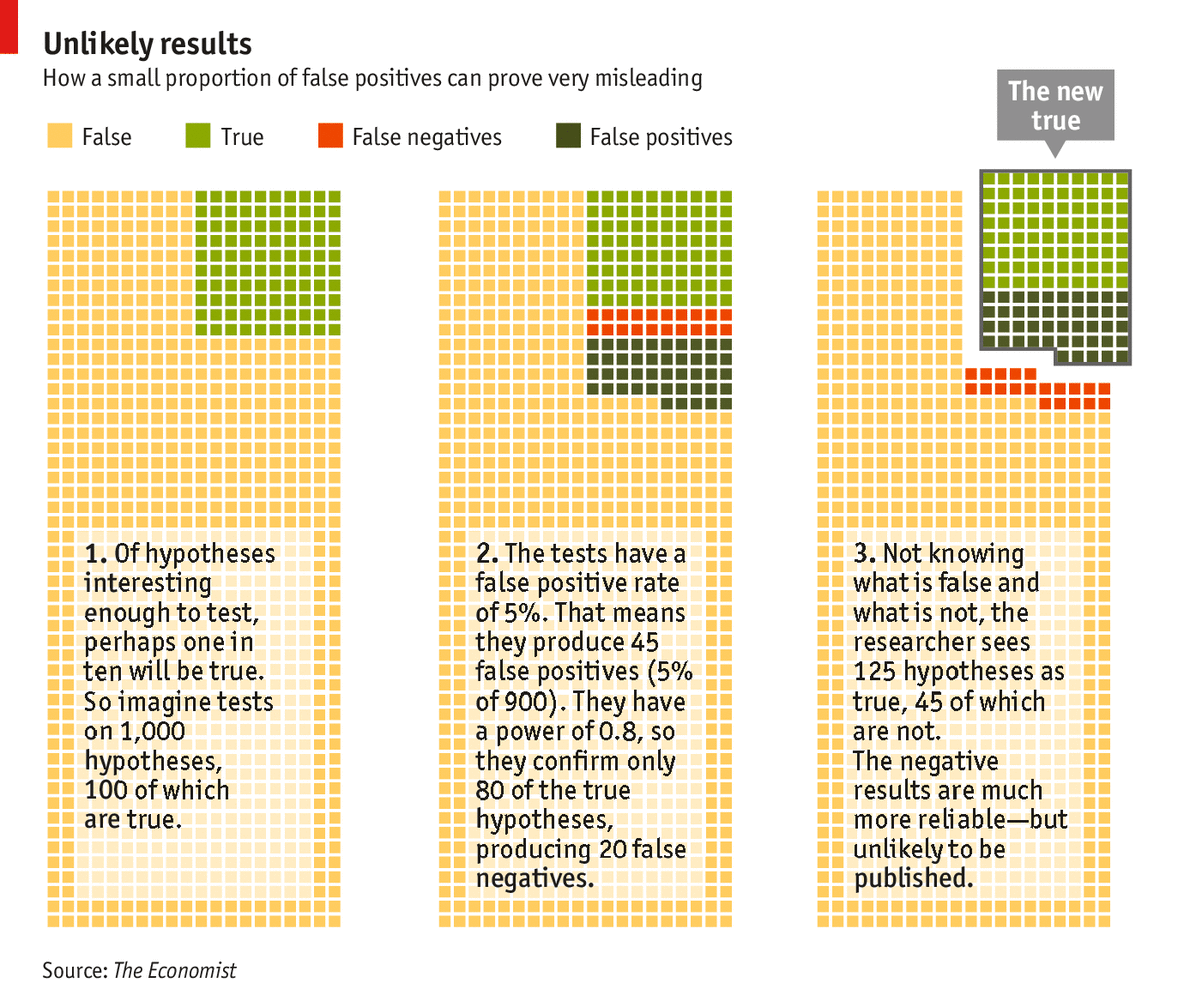
Consider 1,000 hypotheses of which just 100 are true . Studies with a power of 0.8 will find 80 of them, missing 20 because of false negatives. Of the 900 hypotheses that are wrong, 5%—that is, 45 of them—will look right because of type I errors. Add the false positives to the 80 true positives and you have 125 positive results, fully a third of which are specious. If you dropped the statistical power from 0.8 to 0.4, which would seem realistic for many fields, you would still have 45 false positives but only 40 true positives. More than half your positive results would be wrong.

The negative results are much more trustworthy but no one wants to publish those because that ain't how R01 grants get done.

A fascinating look at an ongoing problem.

Trouble at the lab - The Economist

Donate

Please donate so science experts can write for the public.

At Science 2.0, scientists are the journalists, with no political bias or editorial control. We can't do it alone so please make a difference.

Donate with PayPal button 
We are a nonprofit science journalism group operating under Section 501(c)(3) of the Internal Revenue Code that's educated over 300 million people.

You can help with a tax-deductible donation today and 100 percent of your gift will go toward our programs, no salaries or offices.

Latest reads

Article teaser image
No, Trump’s Executive Orders Can’t Cancel Your Rights.
Donald Trump does not have the power to rescind either constitutional amendments or federal laws by mere executive order, no matter how strongly he might wish otherwise. No president of the United…
Article teaser image
The US Discourages Pregnant Women From Drinking Alcohol - Vegetarian Diets Are Worse
The Biden administration recently issued a new report showing causal links between alcohol and cancer, and it's about time. The link has been long-known, but alcohol carcinogenic properties have been…
Article teaser image
In British Iron Age Culture, Margaret Thatcher Was The Norm
In British Iron Age society, land was inherited through the female line and husbands moved to live with the wife’s community. Strong women like Margaret Thatcher resulted.That was inferred due to DNA…

More reads

Featured Image

Despite Their Small Brains -- Ravens Are Just As Clever As Chimps

A study led by researchers at Lund University in Sweden shows that ravens are as clever as chimpanzees, despite having much smaller brains, indicating that rather than the size of the brain, the…
Featured Image

Scientific Method: Concepts Review and Students' Activity

This  post is intended for students in general chemistry class.  
Featured Image

Coral Reefs Recover Quickly After Bleaching Due To Water Temperature Changes

Water has varied in temperature for as long as water has existed and it seems evolution has provided coral reefs a recovery mechanism after variation results in 'bleaching' - when corals expel algae…
Featured Image

Do We Really Want a Technological Explosion?

Often the term technology explosion is used to indicate the rapid growth of technology in areas such as information technology or biotechnology. Usually, the assumption is that innovation creates…

Footer

  • About Us
  • Copyright and Removal
  • Privacy Policy
  • Terms