
Test announcement

Announcement here about some event or update. Or maybe link to promoted article. 

Main navigation

  • Home
  • Culture
    • Humor
    • Mathematics
    • Random Thoughts
    • Science & Society
    • Sports Science
    • Technology
  • Earth Sciences
    • Atmospheric
    • Energy
    • Environment
    • Geology
    • Oceanography
    • Paleontology
  • Life Sciences
    • Ecology & Zoology
    • Evolution
    • Immunology
    • Microbiology
    • Neuroscience
  • Medicine
    • Aging
    • Cancer Research
    • Clinical Research
    • Pharmacology
    • Public Health
    • Vision
  • Physical Sciences
    • Aerospace
    • Applied Physics
    • Chemistry
    • Optics
    • Physics
    • Space
  • Social Sciences
    • Anthropology
    • Archaeology
    • Philosophy & Ethics
    • Psychology
    • Science History
  • Contributors
X XD

User menu

  • Log in

Weekend Science: You Don't Need An Expensive Espresso Grind To Make Great Espresso

By Hank Campbell in Science 2.0
May 24, 2024
Profile picture for user Hank
Submitted by Hank on Fri, 05/24/2024 - 11:54
Old NID
245015

I have three manual espresso machines and a Nespresso and even after years of making them, it can be difficult to get it just right. It takes pressure, understanding the ground beans, and a touch of finesse, which can be more challenging than it sounds.

As beans age they express gases. The carbon dioxide is high right after roasting and after about five days it has leveled out to where you can get the quality, but de-gassing continues to happen, and after a month they are flat. Nothing can stop that physics. It was 1908 Nobel laureate Dr. Ernest Rutherfordwho said, "All science is either physics or stamp collecting", and chemists agreed so much they gave him a Nobel prize. You can slow it down but it will get you.

Buy LaVazza beans from Amazon and they could have been roasted months ago. They will note their flimsy bag is vacuum sealed but even a pressure canister will let in air after a week. A local roaster will put the roasted date in plain sight, and they can tell you based on experience when to grind and use the beans. Yet the aging that has to take place before freshly roasted beans will be just right continues to happen, so you will likely be adjusting your grinder as they change.
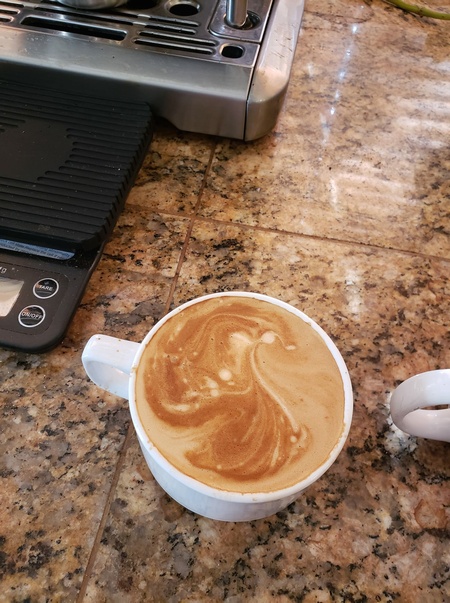

Not an espresso, a latte. Credit: Hank Campbell, Science 2.0

A new study says science can help with that. It won't turn your espresso into art any more than a science of dancing can turn you into Lady Gaga, but it can get you out of any get-together with your dignity intact.

In 1884, Angelo Moriondo of Turin patented the first espresso machine and like pistols and cars from that period, the underlying science hasn't changed all that much.  A whiskey entrepreneur and engineer improved the patent with a portafilter and a pressure release valve. The pressure used to be applied manually but motorized pumps became common in the 1960s.

Yet at its heart it's still the same as 1920; hot water is forced through a puck of finely ground coffee and a filter.

Folk wisdom says you need an ounce of finely ground espresso beans to get a decent pull but if you believed in folk wisdom without hard evidence you wouldn't be here. A 2020 paper sought to determine if extra-fine grinding and ~18 grams of coffee were really needed for espresso.  Coffee freshness and grind will often be the big determinants, I feel like I can pull a great shot with a 1920 manual machine if I can use my grinder and beans roasted two weeks ago. 

I have been at this a while, though. For newer people there is a lot of variation to think about. Too coarse, and you have coffee spraying (at least I do, because I use a bottomless portafilter) and it will be sour while if you are too fine you won't have much and it will be bitter.

The paper found that a coarser grind and less than 18 grams of beans will provide me consistencvy than the 18 in 36 out that is the rule of thumb. The reason is that an overly coarse grind will lead to barely detectable clogging - and that clogging result is hard to predict, much like bad tamping of the puck may lead to channeling and inconsistent flavor.

So if you are unsure of your grinder, or the age of the beans, be conservative and go a little bit coarser with 15 or so fewer beans.

Donate

Please donate so science experts can write for the public.

At Science 2.0, scientists are the journalists, with no political bias or editorial control. We can't do it alone so please make a difference.

Donate with PayPal button 
We are a nonprofit science journalism group operating under Section 501(c)(3) of the Internal Revenue Code that's educated over 300 million people.

You can help with a tax-deductible donation today and 100 percent of your gift will go toward our programs, no salaries or offices.

Latest reads

Article teaser image
No, Trump’s Executive Orders Can’t Cancel Your Rights.
Donald Trump does not have the power to rescind either constitutional amendments or federal laws by mere executive order, no matter how strongly he might wish otherwise. No president of the United…
Article teaser image
The US Discourages Pregnant Women From Drinking Alcohol - Vegetarian Diets Are Worse
The Biden administration recently issued a new report showing causal links between alcohol and cancer, and it's about time. The link has been long-known, but alcohol carcinogenic properties have been…
Article teaser image
In British Iron Age Culture, Margaret Thatcher Was The Norm
In British Iron Age society, land was inherited through the female line and husbands moved to live with the wife’s community. Strong women like Margaret Thatcher resulted.That was inferred due to DNA…

More reads

Featured Image

Use Of Open Access Platforms For Clinical Trial Data

In a study appearing in the March 22/29 issue of JAMA, Ann Marie Navar, M.D., Ph.D., of Duke University Medical Center, Durham, N.C., and colleagues examined how shared clinical trial data are being…
Featured Image

This Maths Model For Covid-19 Guides UK Policy - Its Simulated Flu Differs In Almost Every Detail From The Real Data

This is a trimmed down version of my last article with just the cites from the Imperial college paper to show that in the UK we are indeed using a simulated flu pandemic to guide UK policy and that…
Featured Image

The Daily Physics Problem - 10, 11, 12

As explained in the first installment of this series, these questions are a warm-up for my younger colleagues, who will in two months have to pass a tough exam to become INFN researchers.
Featured Image

Three ways to kill the mosquito disease vectors that cause 10X more deaths than coronavirus

A targeted systemic pesticide treatment like neonicotinoids, based on nature's defenses against bugs, are great for agriculture because it protects plants from pests when they are most vulnerable and…

Footer

  • About Us
  • Copyright and Removal
  • Privacy Policy
  • Terms