Test announcement

Announcement here about some event or update. Or maybe link to promoted article. 

Main navigation

  • Home
  • Culture
    • Humor
    • Mathematics
    • Random Thoughts
    • Science & Society
    • Sports Science
    • Technology
  • Earth Sciences
    • Atmospheric
    • Energy
    • Environment
    • Geology
    • Oceanography
    • Paleontology
  • Life Sciences
    • Ecology & Zoology
    • Evolution
    • Immunology
    • Microbiology
    • Neuroscience
  • Medicine
    • Aging
    • Cancer Research
    • Clinical Research
    • Pharmacology
    • Public Health
    • Vision
  • Physical Sciences
    • Aerospace
    • Applied Physics
    • Chemistry
    • Optics
    • Physics
    • Space
  • Social Sciences
    • Anthropology
    • Archaeology
    • Philosophy & Ethics
    • Psychology
    • Science History
  • Contributors
X XD

User menu

  • Log in

Pesticide Use In Germany Went Down, So Why Are Environmentalists Angry?

By Hank Campbell in Science 2.0
August 18, 2020
Profile picture for user Hank
Submitted by Hank on Tue, 08/18/2020 - 07:28
Old NID
250084

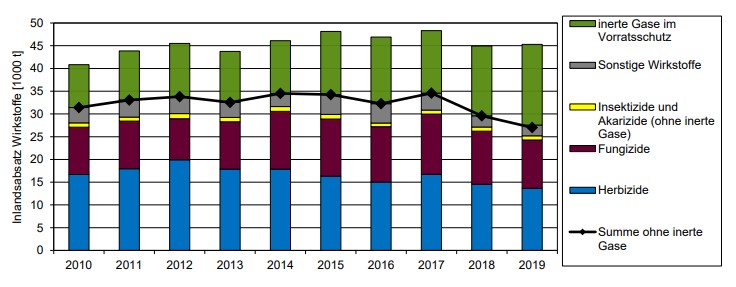
German Federal Ministry of Food and Agriculture data show that use of crop protection products, e.g. pesticides, went down last year and Agriculture Minister Julia Klöckner notes that has been the trend since 2012. Klöckner says it shows Germany is "on the right track" when it comes to reducing use of pesticides but anti-science groups are angry.

They say that the drop in pesticide usage is not good enough. Greenpeace, Friends of the Earth Germany, and Pesticide Action Network Germany all say the reductions could be related to weather and that the government needs to implement more Draconian methods against farmers - unless they are organic farmers.

But that is not a valid scientific position. Copper sulfate, the older, less effective pesticide still considered organic, does not work as well, which means it requires far more in the way of application. If government data included pesticide load per area, it would show that the reduction in Germany would have been far greater if organic farming were not a government-subsidized industry. It is quite literally the case that the increase in organic farming in Germany has held back Germany's commitment to pesticide reduction.
The other thing that has made the difference is greater reliance on imports from Russia. Once Russia began to put organic labels on everything - like their supposed COVID-19 vaccine, there is no evidence Russian organic food is organic and the laws of physics say it likely is not - Germany began to import more. So their domestic food can be more of the "organic" manufacturing process, provided they are willing to turn over a strategic resource like food to their historical enemy.

Activists should not 'make the perfect the enemy of the good' but this new salvo, saying reductions exceeding targets are still not enough, show this is more about raising money than it is helping the environment.


Donate

Please donate so science experts can write for the public.

At Science 2.0, scientists are the journalists, with no political bias or editorial control. We can't do it alone so please make a difference.

Donate with PayPal button 
We are a nonprofit science journalism group operating under Section 501(c)(3) of the Internal Revenue Code that's educated over 300 million people.

You can help with a tax-deductible donation today and 100 percent of your gift will go toward our programs, no salaries or offices.

Latest reads

Article teaser image
No, Trump’s Executive Orders Can’t Cancel Your Rights.
Donald Trump does not have the power to rescind either constitutional amendments or federal laws by mere executive order, no matter how strongly he might wish otherwise. No president of the United…
Article teaser image
The US Discourages Pregnant Women From Drinking Alcohol - Vegetarian Diets Are Worse
The Biden administration recently issued a new report showing causal links between alcohol and cancer, and it's about time. The link has been long-known, but alcohol carcinogenic properties have been…
Article teaser image
In British Iron Age Culture, Margaret Thatcher Was The Norm
In British Iron Age society, land was inherited through the female line and husbands moved to live with the wife’s community. Strong women like Margaret Thatcher resulted.That was inferred due to DNA…

More reads

Featured Image

75% Of Democrats Say Climate Change Is A Major Threat To The United States

In recent Pew Survey data, 75 percent of moderate Democrats believe global climate change is a major threat to the well-being of the United States while 94 percent of Democrats who skew farther left…
Featured Image

High Alpine Dairying May Have Begun Over 3000 Years Ago

The discovery of dairy fats on ancient pottery may indicate dairying high in the Alps occurred as early as the Iron Age over 3000 years ago, according to a study published April 21, 2016 in the open-…
Featured Image

Insects? Lab-Grown Meat? Are You Ready For Lab-Grown Insect Meat?

Pop culture is in a bit of a quandary. Though food is essential for life, culturally it is no longer a basic necessity, and that's thanks to science. We grow more food on less land than ever dreamed…
Featured Image

Losing Weight Can't Cause Cancer But Welcome To Modern Epidemiology

As the century turned, the science community began to become critical of a once-honored field; epidemiology.  If you are not familiar with it, it is people who correlate causes to outcomes. They…

Footer

  • About Us
  • Copyright and Removal
  • Privacy Policy
  • Terms