Test announcement

Announcement here about some event or update. Or maybe link to promoted article. 

Main navigation

  • Home
  • Culture
    • Humor
    • Mathematics
    • Random Thoughts
    • Science & Society
    • Sports Science
    • Technology
  • Earth Sciences
    • Atmospheric
    • Energy
    • Environment
    • Geology
    • Oceanography
    • Paleontology
  • Life Sciences
    • Ecology & Zoology
    • Evolution
    • Immunology
    • Microbiology
    • Neuroscience
  • Medicine
    • Aging
    • Cancer Research
    • Clinical Research
    • Pharmacology
    • Public Health
    • Vision
  • Physical Sciences
    • Aerospace
    • Applied Physics
    • Chemistry
    • Optics
    • Physics
    • Space
  • Social Sciences
    • Anthropology
    • Archaeology
    • Philosophy & Ethics
    • Psychology
    • Science History
  • Contributors
X XD

User menu

  • Log in

Connectome: Howard Hughes Medical Institute Has Mapped The Fruit Fly Brain

By Hank Campbell in Science 2.0
January 23, 2020
Profile picture for user Hank
Submitted by Hank on Thu, 01/23/2020 - 05:30
Old NID
244658

A fruit fly brain may sound meaningless but there is a reason that Howard Hughes Medical Institute spent $40 million and 12 years to map it. And that reason is us.

The hemibrain connectome and its clock neuron circuity contains around 25,000 neurons, which can be grouped into thousands of distinct cell types spanning several brain regions and is the largest synaptic-level connectome ever created. It covers central fly brain circuits critical for associative learning and fly navigation. 
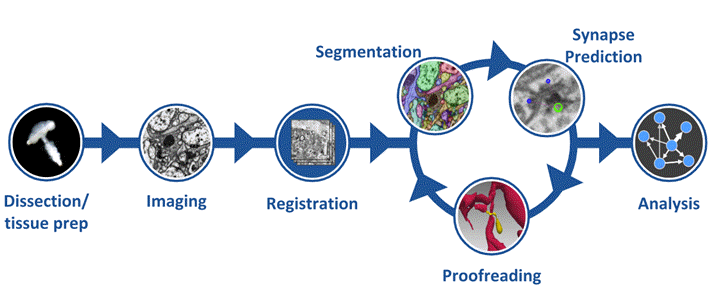
This is not going to lead to any cures in the short term, of course. Fruit flies, mice, epidemiology, they can only ever be exploratory findings, but flies are essential basic research, waypoints on the road to applied science. Though animal studies can never show effects in humans, positive or negative, they can eliminate them, and in science that is a large chunk of the work.

Donate

Please donate so science experts can write for the public.

At Science 2.0, scientists are the journalists, with no political bias or editorial control. We can't do it alone so please make a difference.

Donate with PayPal button 
We are a nonprofit science journalism group operating under Section 501(c)(3) of the Internal Revenue Code that's educated over 300 million people.

You can help with a tax-deductible donation today and 100 percent of your gift will go toward our programs, no salaries or offices.

Latest reads

Article teaser image
No, Trump’s Executive Orders Can’t Cancel Your Rights.
Donald Trump does not have the power to rescind either constitutional amendments or federal laws by mere executive order, no matter how strongly he might wish otherwise. No president of the United…
Article teaser image
The US Discourages Pregnant Women From Drinking Alcohol - Vegetarian Diets Are Worse
The Biden administration recently issued a new report showing causal links between alcohol and cancer, and it's about time. The link has been long-known, but alcohol carcinogenic properties have been…
Article teaser image
In British Iron Age Culture, Margaret Thatcher Was The Norm
In British Iron Age society, land was inherited through the female line and husbands moved to live with the wife’s community. Strong women like Margaret Thatcher resulted.That was inferred due to DNA…

More reads

Featured Image

Motivating Zero Neutrino Mass Scale

 Motivating Zero Neutrino Mass Scale New insight into the phenomenology of neutrino masses is suggested. Four ideas related to new neutrino physics considered: 1) Three absolute neutrino masses…
Featured Image

Predicting Teen Rape: Age Difference, Socioeconomic Status, Other Violent Behavior

Lacking clairvoyant technology as in "The Minority Report", predicting teen rape is impossible, but there are risk factors that can be warning signs. 
Featured Image

Australopithecus Africanus

Two views of a natural endocranial cast articulated with a fragmentary skull of Australopithecus africanus, an early hominid living between 2-3 million years ago in the late Pliocene and into
Featured Image

People Choose Partners With Similar Disease Risk

People choose a life partner who is likely to have a comparable life expectancy and who share similar risks of illnesses - such as high blood pressure or heart disease - according to a genetic study.

Footer

  • About Us
  • Copyright and Removal
  • Privacy Policy
  • Terms