
Test announcement

Announcement here about some event or update. Or maybe link to promoted article. 

Main navigation

  • Home
  • Culture
    • Humor
    • Mathematics
    • Random Thoughts
    • Science & Society
    • Sports Science
    • Technology
  • Earth Sciences
    • Atmospheric
    • Energy
    • Environment
    • Geology
    • Oceanography
    • Paleontology
  • Life Sciences
    • Ecology & Zoology
    • Evolution
    • Immunology
    • Microbiology
    • Neuroscience
  • Medicine
    • Aging
    • Cancer Research
    • Clinical Research
    • Pharmacology
    • Public Health
    • Vision
  • Physical Sciences
    • Aerospace
    • Applied Physics
    • Chemistry
    • Optics
    • Physics
    • Space
  • Social Sciences
    • Anthropology
    • Archaeology
    • Philosophy & Ethics
    • Psychology
    • Science History
  • Contributors
X XD

User menu

  • Log in

Activists Are Enraged The UK Are Allowing Neonics - But The Science Is Clear

By Hank Campbell in Science 2.0
January 13, 2021
Profile picture for user Hank
Submitted by Hank on Wed, 01/13/2021 - 08:01
Old NID
252670

Activists like George Monbiot and Dave Goulson are parroting their environmental allies when it comes to neonics, but the science is clear - without thiamethoxam, sugar beet crops will continue to be devastated because older, less effective (but often certified organic) pesticides really only work if there are no pests to worry about.

Nostalgia is fine for their backyard gardens but not agriculture. In the real world of food production, neonics are better for the environment than legacy products that were sprayed everywhere. Instead of being mass spraying, which can lead to runoff and persistence, neonicotinoids are derived from natural mechanisms. They are seed treatments, for when plants are most vulnerable to pests.

In 2018, the EU had placed a ban on neonicotinoids over the objections of scientists, claiming harmful effects on bees, and England played along. There was no evidence for such deaths, honeybees were not in decline, so professional activists had instead claimed wild bees were being harmed. It was a nice, non-specific symptom because it can't be validated or refuted. There are over 25,000 species of bees, so many we can't create an accurate number because only a tiny fraction even have hives. Claiming they are dying is as easy as claiming the position of the stars in the sky the month you were born created your personality; only gullible people and those selling to them believe it.
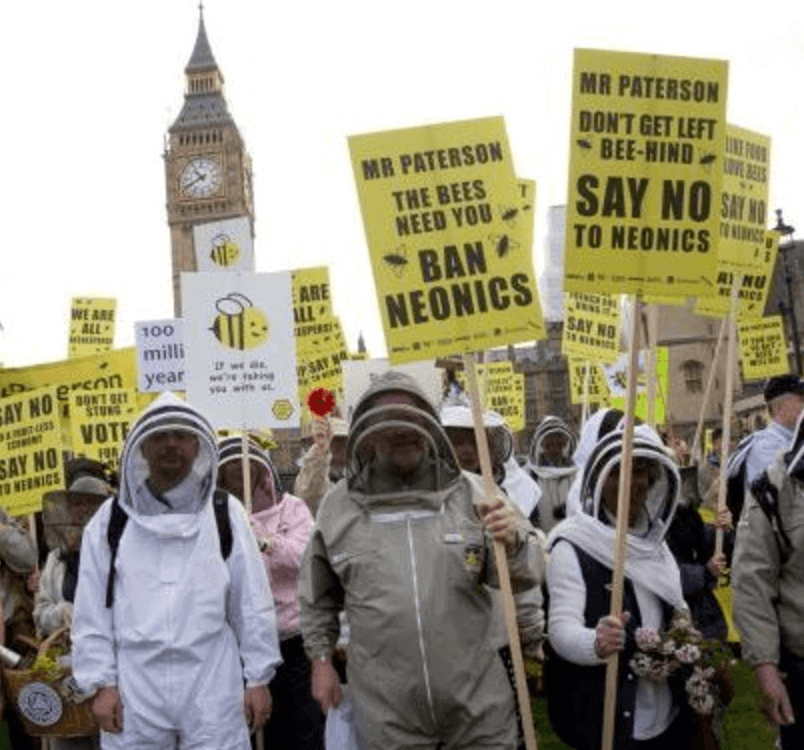

Trust science or people whose funding groups buy brand new outfits to wear to protests? Little wonder people don't trust masks or even vaccines when this kind of thinking is the norm for half of the population.

Meanwhile, the UK had decided to save itself $10 billion each year by disentangling from the EU, which means they no longer had to keep themselves opposed to the science the EU disregards. That is a welcome switch from the country that pioneered "Frankenfood" hysteria about the GMO process and rejuvenated anti-vaccine sentiment with the modern myth that they caused autism. Yet they were not alone. Belgium, Denmark, Spain and France and half a dozen others had already disregarded the EU's centralized wishful thinking. The UK is ignoring people who ignore science, and that is a good thing.

The Guardian, a reliable progressive outlet which has a suspicious financial relationship with organic industry trade groups (donations get made, op-eds by professional deniers for hire like US Right To Know suddenly appear), predictably opposes science yet again, but the virus yellows disease is wrecking crops without good pesticides like thiamethoxam. Guardian ignores the 80 percent losses and claims that refined sugar is bad anyway - they argue that English farmers should go bankrupt because some shady epidemiologist did a food frequency questionnaire and created a correlation. It's all nonsense, and fortunately Europeans governments are siding with science instead.


Donate

Please donate so science experts can write for the public.

At Science 2.0, scientists are the journalists, with no political bias or editorial control. We can't do it alone so please make a difference.

Donate with PayPal button 
We are a nonprofit science journalism group operating under Section 501(c)(3) of the Internal Revenue Code that's educated over 300 million people.

You can help with a tax-deductible donation today and 100 percent of your gift will go toward our programs, no salaries or offices.

Latest reads

Article teaser image
No, Trump’s Executive Orders Can’t Cancel Your Rights.
Donald Trump does not have the power to rescind either constitutional amendments or federal laws by mere executive order, no matter how strongly he might wish otherwise. No president of the United…
Article teaser image
The US Discourages Pregnant Women From Drinking Alcohol - Vegetarian Diets Are Worse
The Biden administration recently issued a new report showing causal links between alcohol and cancer, and it's about time. The link has been long-known, but alcohol carcinogenic properties have been…
Article teaser image
In British Iron Age Culture, Margaret Thatcher Was The Norm
In British Iron Age society, land was inherited through the female line and husbands moved to live with the wife’s community. Strong women like Margaret Thatcher resulted.That was inferred due to DNA…

More reads

Featured Image

To MAGAs, The Constitution Isn’t The Point

1.     January 6 was a shocking aberration.
Featured Image

Understanding Expected Limits, Observed Limits, Exclusion Regions In Particle Physics Graphs

I recently got engaged in a conversation with a famous retired mathematician / cosmologist about the phenomenology of Higgs bosons in the Standard Model of particle physics, and very soon we ended up…
Featured Image

Cryptotora Thamicola: Blind Fish Walks The Way Land Vertebrates Do

Researchers have identified unique anatomical features in a species of blind, walking cavefish in Thailand that enable the fish to walk and climb waterfalls in a manner comparable to tetrapods, or…
Featured Image

Flowers Critical Link To Bacteria Transmission In Wild Bees

RIVERSIDE, Calif. -- A team of researchers, including several from the University of California, Riverside, have found that flowers are a hot spot of transmission of bacteria that end up in the…

Footer

  • About Us
  • Copyright and Removal
  • Privacy Policy
  • Terms